

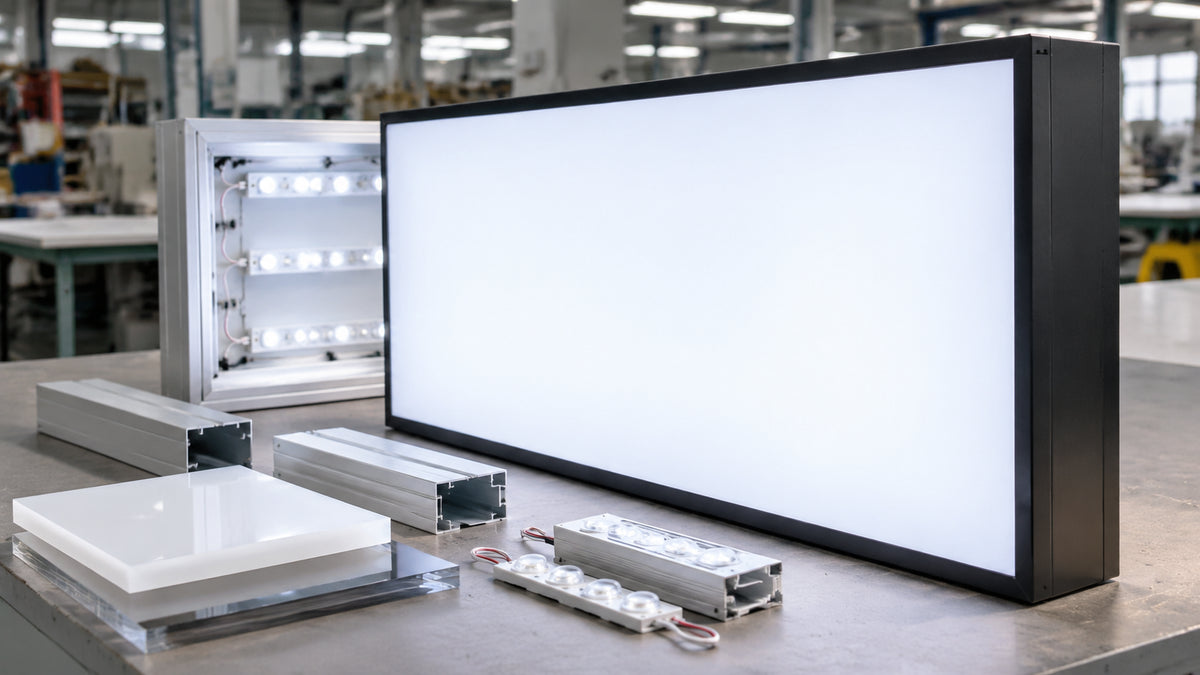
The cost of a custom lightbox sign depends on its size, cabinet construction, face materials, lighting system, design complexity, and order quantity. Two lightboxes with similar dimensions can have different prices because their manufacturing requirements differ. Understanding these factors helps buyers compare quotations and identify opportunities to control costs without compromising essential product requirements.
1. How Do Size, Shape, and Cabinet Construction Affect Cost?
Size affects material consumption, but it is not the only factor determining the cost of a custom lightbox. The overall shape, cabinet depth, structural requirements, and fabrication methods also influence manufacturing expenses.
Size and depth:
Larger lightboxes generally require more face material, framing, and internal support. Cabinet depth can also affect material usage and the lighting arrangement. A shallow cabinet is not automatically less expensive if achieving even illumination requires more specialized components.
Shape and fabrication:
Standard rectangular lightboxes are generally simpler to fabricate than products with curved outlines, complex contours, or multiple dimensional elements. Custom shapes may require additional cutting, forming, welding, and assembly.
Cabinet construction:
Framed, frameless, recessed, and other custom structures involve different manufacturing processes. A simple aluminum-profile cabinet and a specially fabricated metal enclosure may have very different material and labor requirements.
For example, a rectangular acrylic-faced lightbox and a custom-shaped push-through lightbox may have similar overall dimensions, but the latter can require additional fabrication to accommodate dimensional illuminated graphics.
For a closer look at these structural differences, see Normal vs. Push-Through Lightbox Signs: Which Face Construction Fits Your Project?.
2. How Do Face Materials and Graphic Finishes Change the Price?
The display face influences both the finished appearance and manufacturing cost. Material choice should reflect the intended visual effect, required dimensions, installation environment, and whether graphics need to be replaced.
Common options include:
- Acrylic faces: Rigid panels that can be produced with translucent colors, printed graphics, or other surface treatments.
- Fabric faces: Flexible printed surfaces commonly used with tensioned frame systems, particularly for large-format displays.
- Specialty face construction: Push-through lettering, cut-out details, layered materials, and other dimensional treatments.
The cost difference comes not only from the material price but also from processing and assembly.
A flat printed acrylic face may involve relatively straightforward fabrication, while a design combining opaque metal panels with individually fitted illuminated acrylic graphics requires additional manufacturing steps.
Graphic complexity matters as well. Custom printing, multiple finishes, precise color matching, and layered visual effects can increase production requirements.
However, an expensive material is not automatically the most appropriate choice. For a large promotional display with replaceable graphics, a fabric system may offer practical advantages over a rigid face. For a permanent dimensional logo, a more specialized acrylic or metal construction may better achieve the intended result.
The most useful question is not simply which material costs less, but which construction delivers the required appearance and function without unnecessary complexity.
3. How Does the Lighting System Affect Manufacturing Cost?
The lighting system affects the cost of LEDs, power supplies, internal components, and assembly. The required illumination area, cabinet depth, face material, and expected visual performance all influence the configuration.
Two common approaches are backlit and edge-lit illumination.
Backlit systems position light sources behind the display face, while edge-lit systems introduce light through the edges of a light-guiding panel. Their component arrangements and structural requirements differ.
For a more detailed explanation, see Backlit vs. Edge-Lit Lightboxes: What's the Difference?.
Several factors can influence lighting costs:
- Illuminated area: Larger or irregular surfaces may require more complex LED distribution.
- Cabinet depth: Available space affects LED positioning and light diffusion.
- Brightness requirements: Different environments and face materials may require different lighting configurations.
- Electrical components: Power supply specifications, wiring arrangements, and environmental protection requirements affect component selection.
Reducing the number of LEDs is not necessarily an effective way to lower costs. Poorly planned lighting can produce hotspots, dark areas, or uneven brightness, undermining the appearance of the finished sign.
A better approach is to design the cabinet, face material, and lighting arrangement together so the required visual result can be achieved efficiently.
4. Does Ordering More Lightboxes Reduce the Unit Cost?
Larger quantities can reduce the unit manufacturing cost of custom lightboxes, particularly when the products share the same dimensions, materials, construction, and graphics.
Some manufacturing activities, such as engineering preparation, machine setup, and production planning, are required regardless of whether the order contains one unit or several identical units. Repeating the same design can distribute these setup costs across more products.
However, total order quantity and quantity per design are not the same thing.
An order for 50 identical lightboxes may offer greater production efficiency than an order for 50 lightboxes with different sizes, shapes, and face materials.
The potential savings depend on how much of the manufacturing process can be repeated.
For buyers ordering several designs, standardizing selected components can also help. Using common cabinet profiles, materials, electrical configurations, or mounting arrangements may reduce unnecessary production variation.
This does not mean every lightbox needs to look identical. Different graphics can still be used where the underlying construction permits.
Buyers should ask the manufacturer whether standardizing certain specifications would improve manufacturing efficiency and how the proposed changes would affect the quotation.
5. How Can Buyers Reduce Custom Lightbox Costs Without Compromising the Result?
Cost optimization should begin during product design, not after the manufacturer has finalized the quotation. The objective is to remove unnecessary manufacturing complexity while preserving the required appearance, functionality, and structural performance.
Several approaches are worth considering.
Simplify construction where appropriate. Complex contours, unnecessary framing details, and elaborate assemblies can increase fabrication work. Where the visual design permits, simpler structures may be more economical.
Choose materials according to their function. Heavy or specialized materials are not always necessary for every component. The manufacturer can evaluate whether alternative materials provide sufficient strength, appearance, and environmental resistance.
Standardize repeatable components. Common profiles, materials, and electrical configurations may improve production efficiency across multiple units.
Consider transportation during design. Oversized or heavy lightboxes may require more expensive packaging and handling. Modular construction can sometimes simplify transportation, although its additional joints, assembly requirements, and installation costs must also be considered.
Real Project Example: Jambo Mart Commercial Complex
LC Sign applied this approach in the Jambo Mart Commercial Complex signage project in the Democratic Republic of the Congo.
The project included large outdoor lightboxes, and the original design used a heavy internal steel chassis that exceeded the contractor's budget.
To address the cost constraint, LC Sign redesigned the lightboxes around a modular aluminum flip-frame system, using high-tenacity knife-coated fabric for the illuminated faces and aluminum composite back panels.
This revised construction reduced material weight and cost while maintaining the required flat visual finish. The modular design also helped accommodate transportation constraints for the oversized structures.
The project illustrates how evaluating the structural system as a whole can create opportunities for cost reduction without simply removing components or reducing lighting performance.

For buyers, the practical lesson is to discuss alternative constructions with the manufacturer before finalizing the design. Material substitutions and structural changes should be evaluated against the project's visual, installation, and safety requirements.
Conclusion
The cost of a custom lightbox sign reflects its complete manufacturing requirements, not just its external dimensions. Cabinet construction, face materials, lighting configuration, design complexity, and order quantity all influence the final quotation.
Buyers can make more informed decisions by identifying which product features are essential and where alternative materials, simpler structures, or standardized components may provide better value.
Once the design direction and budget are established, the next step is to confirm the production specifications and quotation scope. For practical guidance, read What Should You Ask Before Ordering Custom Lightboxes in Bulk?.
Planning a custom lightbox project? Contact LC Sign for custom quotes.
Frequently Asked Questions
Is a Custom-Shaped Lightbox Always More Expensive Than a Rectangular One?
Not necessarily. Custom shapes often involve additional cutting, forming, or assembly, but the final cost also depends on the materials, dimensions, lighting system, and order quantity. A simple custom shape may cost less than a rectangular lightbox with complex materials or illumination requirements.
Does Ordering More Lightboxes Automatically Lower the Unit Price?
No. Higher quantities can improve production efficiency when units share the same specifications. Orders containing many different designs may still require separate engineering, setup, and fabrication work. The potential unit-cost reduction depends on how much of the manufacturing process can be repeated.
Can LC Sign Recommend a More Cost-Effective Lightbox Construction?
Yes. LC Sign can evaluate alternative materials and structural configurations according to the project's design, dimensions, application, and budget. For example, the Jambo Mart project used a redesigned aluminum and fabric lightbox system to reduce material weight and cost. Any proposed alternative should be reviewed against the required visual and structural performance before approval.
Does the Custom Lightbox Price Include Shipping and Installation Accessories?
Not necessarily. Quotation scope varies by product and project. Buyers should confirm whether mounting accessories, protective packaging, shipping, and other related items are included. Installation services, where required, should be clarified separately before placing the order.
Recommended reading
What Should You Ask Before Ordering Custom Lightboxes in Bulk?
Pylon Signs: Types, Structures & Applications
How to Choose the Right Mini LED Letters for Your Signage Project
How to Choose the Right Metal Finish for Custom Signs
Recommended products
LC-XFL02 · LED Frontlit Rimless Letters & Signs