

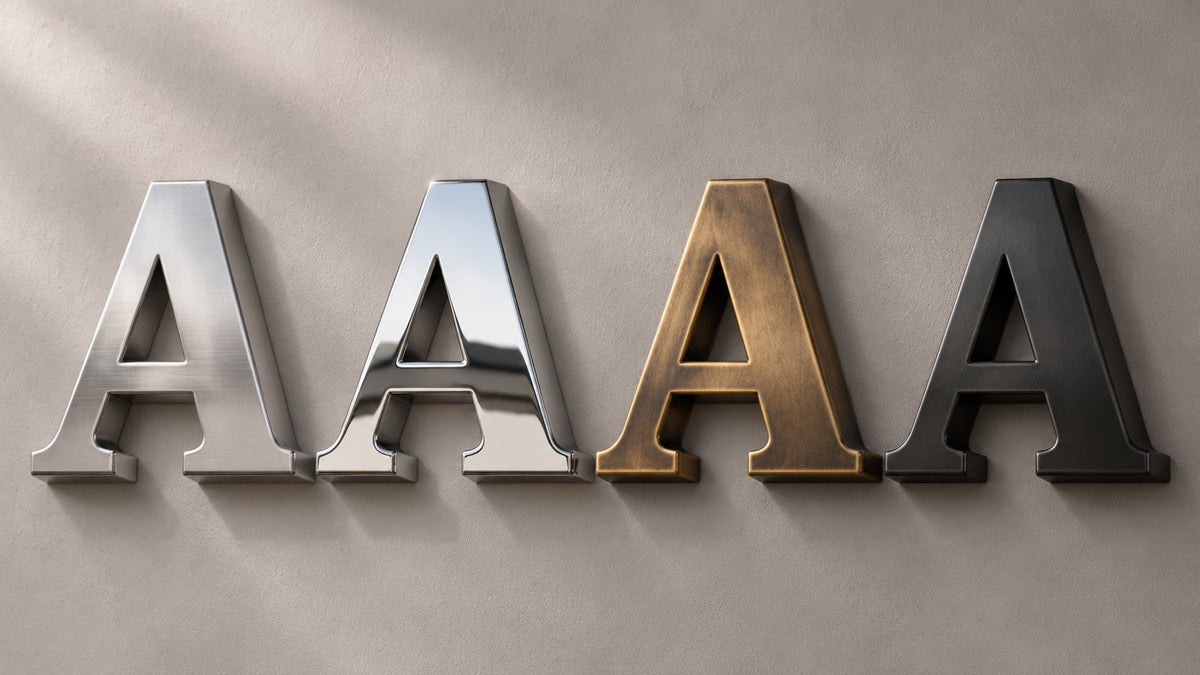
The right metal finish depends on the base material, desired appearance, installation environment, and maintenance requirements. Brushed and mirror-polished finishes create different surface textures and reflections, while antiqued, blackened, painted, and metallic-effect finishes offer additional decorative options. Because not every treatment is suitable for every metal, buyers should confirm material compatibility before specifying a finish.
1. What Are the Main Surface Finishes for Custom Metal Signs?
Metal sign finishes can be created through mechanical surface treatment, decorative treatments, applied coatings, or electrochemical processes. Each method produces a different appearance and may require specific base materials and production conditions.
Understanding how these treatments differ helps buyers select a finish based on both visual requirements and practical considerations.
1.1 Brushed Finish
A brushed finish is produced by mechanically working the metal surface with abrasive belts, brushes, or other finishing tools to create a directional grain.
Unlike a mirror-polished surface, brushing retains visible linear textures and produces a softer, more controlled reflection.
The appearance of a brushed finish depends on several factors:
- Grain Direction: Brushing can produce horizontal, vertical, or other directional patterns. The direction should be considered in relation to the shape and orientation of the sign.
- Grain Fineness: Fine brushing creates a subtle, refined texture, while more pronounced grain produces a stronger directional appearance.
- Surface Uniformity: Consistent grain direction and texture are important when multiple letters or panels form one signage system.
Common industry descriptions include hairline, satin-brushed, and directional brushed finishes. However, these terms are not always used consistently between manufacturers.
For multi-component signs, buyers should specify the desired appearance and review a physical sample rather than relying on the finish name alone.
Brushed finishes are commonly considered for stainless steel, brass, and aluminum signage where a visible metallic texture is preferred without strong mirror reflections.
1.2 Mirror-Polished Finish
Mirror polishing is a mechanical finishing process that uses progressively finer abrasives and polishing compounds to create a smooth, highly reflective metal surface.
Compared with brushed finishes, mirror-polished surfaces have fewer visible directional grain marks and reflect surrounding objects and light more clearly.
This finish is often selected for decorative metal letters, corporate logos, reception signage, and architectural branding where a high-gloss metallic appearance is desired.
However, high reflectivity also makes fingerprints, scratches, and surface imperfections more noticeable.
Buyers should consider the surrounding lighting, wall color, and viewing angles before choosing a mirror finish, particularly for large signage installations.
1.3 Sandblasted Finish
Sandblasting is a mechanical surface treatment in which abrasive particles are propelled against a metal surface to create a textured or matte appearance.
The resulting texture depends on the abrasive media, particle size, blasting pressure, and processing conditions.
Compared with brushed finishes, sandblasted surfaces generally have a more uniform, non-directional texture.
This makes sandblasting useful when a softer, less reflective metallic appearance is required.
For custom signage, sandblasted stainless steel can be considered for architectural lettering and decorative metal panels where a matte surface is preferred over a polished or directional finish.
Sandblasting can also be used as a surface-preparation step before certain coating processes. It should not, however, be confused with a protective coating or treated as a guarantee of corrosion resistance.
1.4 Antiqued and Blackened Finishes
Antiqued and blackened finishes create decorative surface effects that change the natural appearance of metal.
An antiqued finish produces an intentionally aged appearance, often incorporating darker tones and variations that emphasize the character of the metal.
A blackened finish creates a darker surface appearance, ranging from deep metallic tones to more pronounced black effects.
These treatments are particularly relevant to decorative metal letters, architectural details, and dimensional relief signs.
On raised and recessed surfaces, variations in color can emphasize the depth and texture of the design.
However, antiqued and blackened are descriptions of the finished appearance rather than one universal manufacturing process. The actual treatment can differ depending on the base metal.
For example, LC Sign offers antiqued and blackened treatments for copper, brass, and aluminum. The resulting appearance varies according to the material and finishing method.
Buyers should review an approved sample to establish the expected color, tonal variation, and surface appearance.
1.5 Baked-Painted and Powder-Coated Finishes
Painted finishes allow metal signs to achieve specified colors beyond the natural appearance of the base material.
Two relevant coating methods are baked painting and powder coating.
Baked Painting
Liquid paint is applied to the prepared metal surface and subsequently cured through a controlled heating process, according to the coating specification.
It can provide different solid colors, gloss levels, and decorative appearances.
Powder Coating
Powder coating applies dry coating powder to a prepared surface, typically through electrostatic application, followed by heat curing to form a continuous coating film.
It is commonly used where a consistent colored finish and a durable coating system are required.
Although both methods can involve baking or heat curing, they are different application processes and should not be treated as interchangeable.
For custom signs, the appropriate method depends on the base material, component geometry, required appearance, and coating specification.
1.6 Electroplated Finish
Electroplating is an electrochemical process that deposits a layer of metal onto a conductive substrate using an electric current and an electrolyte containing metal ions.
The deposited metal changes the surface appearance and can introduce different decorative metallic colors and finishes.
Depending on the plating metal and process, electroplated surfaces may achieve effects such as gold-toned, chrome-like, or other metallic appearances.
Electroplating is different from mirror polishing: polishing mechanically smooths the original metal surface, while electroplating deposits an additional metallic layer.
For custom signage, electroplating can be considered for decorative stainless steel letters, logos, and architectural components requiring a specified metallic appearance.
The final result depends on the substrate, surface preparation, deposited metal, coating thickness, and subsequent treatment.
Buyers should confirm the required color and environmental suitability with the manufacturer rather than assuming all plated finishes have identical performance.
1.7 Metallic-Effect Spray Coating
Metallic-effect spray coating uses spray equipment to apply a specially formulated coating that creates a decorative metallic appearance or color effect on the base material.
Unlike electroplating, this process does not rely on electrochemical deposition of a metal layer.
It allows aluminum components to achieve different metallic-looking colors and surface effects while retaining aluminum as the base material.
This option can be useful when a project requires a decorative metallic appearance without using solid copper, brass, or another metal as the substrate.
The final appearance and durability depend on the coating formulation, surface preparation, application conditions, and curing process.
For buyers, the important distinction is that a metallic-effect sprayed finish is a decorative coating, not genuine metal plating.
1.8 Anodized Finish
Anodizing is an electrochemical surface treatment primarily used for aluminum.
During the process, the aluminum component is made the anode in an electrolytic bath, forming a controlled oxide layer on its surface.
This oxide layer becomes part of the aluminum surface rather than an independently applied paint film.
Depending on the alloy and anodizing specification, the process can provide different surface appearances and color options.
Anodizing is used when the project requires a treated aluminum surface with specific decorative or functional characteristics.
The final appearance depends on the aluminum alloy, surface preparation, anodizing process, and any subsequent coloring or sealing.
Anodizing should not be confused with electroplating: anodizing modifies the aluminum surface through oxide formation, whereas electroplating deposits another metal onto a substrate.
2. Which Metal Finishes Are Available for Different Materials?
The base material determines which finishing methods are available and how the finished surface will look.
Stainless steel, copper, brass, and aluminum each have different natural appearances and respond differently to surface treatments.
The following table summarizes LC Sign's confirmed finishing options.
| Surface Finish | Stainless Steel | Copper | Brass | Aluminum |
|---|---|---|---|---|
| Brushed | ✓ | — | ✓ | ✓ |
| Mirror-Polished | ✓ | — | ✓ | — |
| Sandblasted | ✓ | — | — | — |
| Antiqued | — | ✓ | ✓ | ✓ |
| Blackened | — | ✓ | ✓ | ✓ |
| Baked-Painted | ✓ | — | ✓ | ✓ |
| Powder-Coated | ✓ | — | — | — |
| Electroplated | ✓ | — | — | — |
| Metallic-Effect Sprayed | — | — | — | ✓ |
| Anodized | — | — | — | ✓ |
The table reflects LC Sign's currently confirmed material and finishing capabilities. A dash indicates that the combination has not been confirmed as an available option, not that it is technically impossible.
Stainless Steel
Stainless steel supports several mechanical and coating-based finishes.
LC Sign offers:
- Brushed
- Mirror-polished
- Sandblasted
- Electroplated
- Powder-coated
- Baked-painted
These options allow stainless steel signs to achieve different appearances, from natural metallic textures to reflective decorative surfaces and specified colors.
Brushed and sandblasted finishes are useful when strong mirror reflections are not desired, while mirror polishing creates a more reflective appearance.
Electroplating and painted finishes provide additional decorative possibilities.
The choice should account for the stainless steel grade, surface preparation, coating specification, and installation environment.
Copper
Copper has a naturally reddish appearance and is particularly suitable for decorative finishes that emphasize aged or darkened metal effects.
LC Sign offers two main finishing options for copper:
- Antiqued
- Blackened
These treatments can create different dark reddish-brown and aged metallic appearances.
They are particularly relevant to decorative reliefs and architectural details where the visual character of copper is an important part of the design.
Brass
Brass has a naturally warm yellow-gold appearance and supports several decorative surface treatments.
LC Sign offers:
- Brushed
- Mirror-polished
- Antiqued
- Blackened
- Baked-painted
Brushed brass retains a directional metallic texture, while mirror-polished brass produces a more reflective golden appearance.
Antiqued and blackened finishes create darker decorative effects, and baked painting allows the surface to achieve specified colors.
These options make brass suitable for different architectural and decorative signage styles.
Aluminum
Aluminum has a naturally silver-gray appearance and is significantly lighter than copper and brass at comparable material volumes.
LC Sign offers:
- Brushed
- Antiqued
- Blackened
- Baked-painted
- Metallic-effect sprayed
- Anodized
Brushed aluminum retains a visible metallic grain, while painted and metallic-effect sprayed finishes offer different decorative color possibilities.
Anodizing provides an additional option for suitable aluminum materials through electrochemical surface modification.
For large or lightweight signage components, aluminum can be considered when the design requires a balance between material weight and surface appearance.
The key point is that a finish should never be selected independently of its base material. A desired appearance may be achievable through several different material-and-finish combinations, but the resulting surface characteristics will not necessarily be identical.
For a closer comparison of copper, brass, and aluminum, see our guide to choosing the right material for custom metal relief signs.
3. How Do Texture, Reflectivity, and Color Affect the Finished Sign?
The same metal can look very different depending on how its surface is treated.
For B2B signage projects, three visual characteristics deserve particular attention: texture, reflectivity, and color consistency.
Texture and Grain Direction
Texture affects how a metal sign looks and feels.
Brushed surfaces have directional grain, while sandblasted surfaces generally produce a more uniform, non-directional matte texture.
For brushed metal letters, grain direction should be considered across all components.
For example, letters installed side by side may look inconsistent if their brushing directions differ, even when they use the same material and finish.
Buyers should confirm whether the design requires a consistent horizontal, vertical, or other specified grain direction.
Reflectivity and Lighting
Reflectivity influences how clearly a sign displays its metallic surface under different lighting conditions.
Mirror-polished finishes reflect surrounding objects and light sources, creating strong highlights.
Brushed and sandblasted surfaces generally produce softer reflections, while antiqued and blackened finishes emphasize darker tonal characteristics.
A highly reflective finish may look attractive in a controlled showroom but produce distracting glare when installed opposite windows or strong lighting.
For this reason, finish selection should consider the actual viewing environment rather than appearance in a product photograph alone.
Color and Visual Consistency
Metallic colors can appear different depending on the surface texture and gloss level.
For example, brushed brass and mirror-polished brass may have noticeably different visual effects even though they use the same base metal.
Similarly, painted finishes and metallic-effect sprayed finishes may require different color references and approval methods.
For projects involving multiple signs, buyers should establish a clear reference for:
- Color and metallic tone
- Gloss level
- Surface texture
- Brushing direction
- Acceptable finish variation
This is especially important for projects involving multiple locations or repeat orders.
4. Which Metal Finishes Are Suitable for Indoor and Outdoor Use?
The installation environment affects the selection of both the base material and its surface treatment.
A finish that creates the desired appearance indoors may not necessarily provide suitable performance in an exposed exterior environment.
The appropriate choice depends on the metal grade, coating specification, surface preparation, environmental exposure, and maintenance requirements.
| Finish Type | Main Environmental Consideration | Maintenance Consideration |
|---|---|---|
| Brushed | Base-metal corrosion resistance and surface condition | Cleaning methods that preserve the grain |
| Mirror-Polished | Substrate suitability and exposure conditions | Fingerprints, scratches, and visible marks |
| Sandblasted | Base-metal corrosion resistance and surface texture | Cleaning textured surfaces |
| Antiqued / Blackened | Stability of the treatment and any protective layer | Acceptable changes in tone and appearance |
| Baked-Painted / Powder-Coated | Coating specification and environmental exposure | Coating damage and surface cleaning |
| Electroplated | Plating system, adhesion, and substrate preparation | Wear and changes in coating appearance |
| Metallic-Effect Sprayed | Coating formulation and application quality | Surface damage and coating maintenance |
| Anodized | Aluminum alloy and anodizing specification | Appropriate cleaning and surface care |
What Should Buyers Consider for Outdoor Signs?
Outdoor signs may be exposed to rain, humidity, ultraviolet radiation, temperature changes, and airborne contaminants.
Coastal and industrial environments may introduce additional corrosion-related concerns.
For stainless steel, the selected grade is important. Brushing, mirror polishing, or sandblasting alone does not guarantee suitability for every outdoor environment.
For painted and coated surfaces, the coating system should be selected according to the expected exposure conditions.
Similarly, antiqued and blackened decorative finishes should be evaluated based on their specific treatment and any protective layer.
For anodized aluminum, the alloy and anodizing specification influence the resulting surface characteristics.
Buyers should therefore confirm exterior suitability for the complete material-and-finish combination rather than relying on a general finish name.
How Does Maintenance Affect Finish Selection?
Different surface appearances create different cleaning and maintenance requirements.
Mirror-polished surfaces can make fingerprints and scratches more visible, while textured surfaces may require additional attention during cleaning.
Painted and coated surfaces should be inspected for damage that could affect their appearance or protective function.
Antiqued finishes may also develop visual changes over time, depending on the treatment and environmental exposure.
The best choice depends on how the sign is used, how frequently it is handled, and whether gradual changes in appearance are acceptable.
5. How Should Buyers Compare and Approve Metal Finish Samples?
A finish name alone may not communicate the exact appearance required for a custom signage project.
Terms such as brushed, satin, mirror, and antiqued can describe different results depending on the material and manufacturer's process.
For this reason, reviewing representative finish samples is an important part of specifying custom metal signs.
What Should Buyers Check Before Approval?
| Review Item | What to Confirm |
|---|---|
| Base Material | The sample uses the agreed metal or an identified representative substrate |
| Color | The appearance matches the intended reference |
| Texture | Brushing, polishing, blasting, or decorative effects meet expectations |
| Grain Direction | Directional textures are consistent across components |
| Gloss and Reflectivity | Reflections are appropriate for the installation environment |
| Surface Uniformity | Acceptable variations are clearly established |
| Environmental Suitability | The finish specification matches the intended exposure |
| Repeat Orders | Approved finish references are retained for future production |
Why Are Physical Samples Important?
Digital images can help communicate the desired appearance, but they may not accurately reproduce metallic reflections, surface grain, or subtle color differences.
Camera exposure, white balance, and surrounding lighting can significantly change how a metal finish appears in photographs.
For example, mirror-polished metal may reflect a dark environment and appear darker than expected.
Brushed metal may also show different highlights depending on the direction of its grain.
When the finish is central to the design, a physical sample made from the intended material and finishing process provides a more reliable basis for approval.
How Can Finish Consistency Be Maintained Across Multiple Signs?
For projects involving multiple signs, consistency should be considered before production begins.
The approved finish reference should identify the base material, color, gloss, texture, grain direction, and acceptable variations.
For repeat orders, retaining the approved sample and relevant finishing specifications can reduce uncertainty between production batches.
However, exact visual matching may still require additional inspection, particularly for decorative finishes with intentional tonal variations or reflective metallic surfaces.
The objective is to establish an agreed appearance that can be evaluated consistently throughout the project.
Conclusion
Choosing the right metal finish involves more than selecting a color or texture. Brushed, mirror-polished, sandblasted, antiqued, blackened, painted, plated, metallic-effect sprayed, and anodized finishes each create different visual results and have different material requirements.
The most suitable option depends on the base metal, desired appearance, installation environment, and maintenance expectations.
For custom signage, buyers should confirm material compatibility, review representative finish samples, and establish clear specifications before production.
Choosing a finish for your custom metal sign? Share your design, base material, and desired appearance with LC Sign to review suitable finishing options.
Frequently Asked Questions
What Is the Difference Between Brushed and Mirror-Polished Metal Finishes?
Brushed finishes have visible directional grain that produces a softer, less reflective appearance. Mirror-polished finishes use mechanical polishing to create a smooth, highly reflective surface. The better choice depends on the desired visual effect, surrounding lighting, and maintenance expectations.
What Is the Difference Between Electroplating and Metallic-Effect Spray Coating?
Electroplating uses an electrochemical process to deposit a metallic layer onto a conductive substrate. Metallic-effect spray coating applies a formulated coating through spray equipment to create a decorative metallic appearance. The two processes differ in their application methods, coating composition, and resulting surface characteristics.
Can the Same Metal Be Finished in Different Colors and Textures?
Yes, depending on the base material and available finishing methods. For example, brass can receive brushed, mirror-polished, antiqued, blackened, and baked-painted finishes, while aluminum supports options including brushed, antiqued, blackened, baked-painted, metallic-effect sprayed, and anodized finishes.
Are Brushed Metal Signs Suitable for Outdoor Use?
Brushed metal signs can be considered for outdoor applications, but suitability depends on the base metal, material grade, environmental exposure, and any additional protective treatment. A brushed finish alone does not guarantee corrosion resistance or long-term outdoor performance.
How Can Buyers Maintain Consistent Finishes Across Multiple Signs?
Buyers should establish an approved physical sample and document the material, color, gloss level, texture, grain direction, and acceptable variations. Retaining these references for repeat orders helps manufacturers evaluate whether new components match the approved appearance.
Recommended reading
Copper, Brass, or Aluminum Which Is Best for Metal Relief Signs
How to Choose the Right Mini LED Letters for Your Signage Project
Flat-Cut vs. Fabricated Metal Letters: Which Is Right for Your Sign?
Can Any Logo or Font Be Made into Channel Letters? Design & Fabrication Limits
Recommended products
LC-XFL02 · LED Frontlit Rimless Letters & Signs