

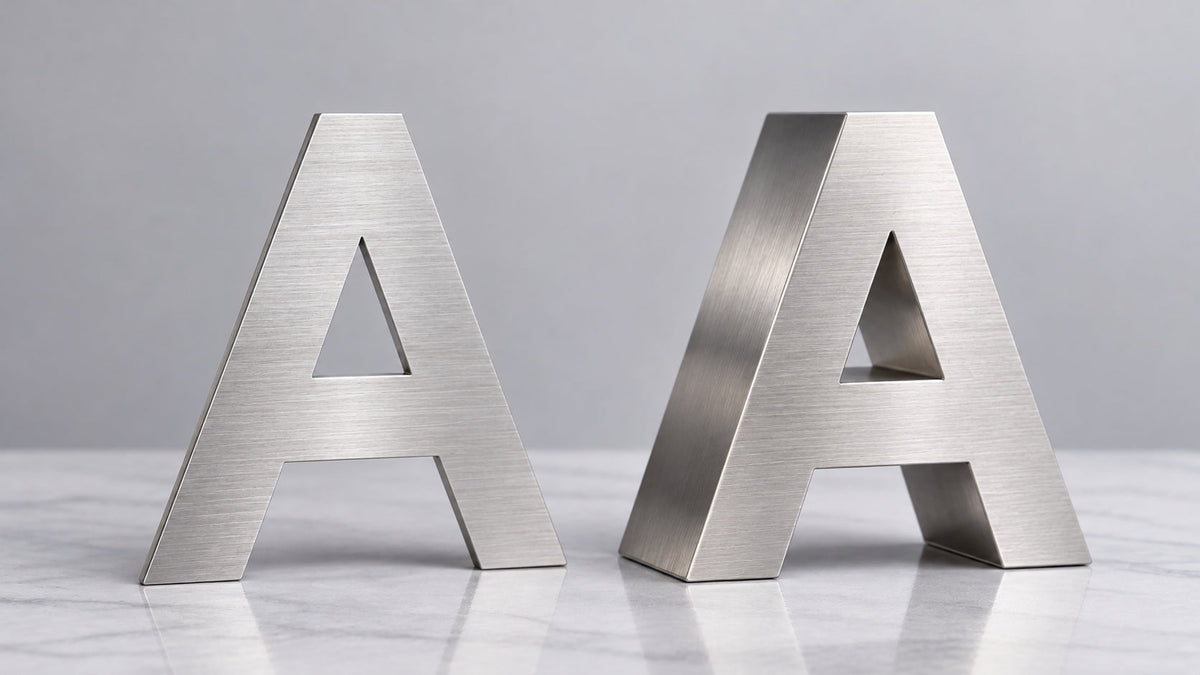
Flat-cut metal letters are cut from solid metal sheets or plates, while fabricated metal letters are assembled from separate components to create hollow, three-dimensional structures. Flat-cut letters suit many low-profile designs, while fabricated letters allow greater flexibility in body depth. The right choice depends on the desired appearance, letter dimensions, mounting conditions, and budget.
1. What Is the Difference Between Flat-Cut and Fabricated Metal Letters?
Both flat-cut and fabricated metal letters are commonly used for non-illuminated business signs, architectural lettering, and interior branding. They can be made with similar metal finishes and may look alike when viewed directly from the front.
Their main difference is how the letter body is constructed.
Flat-cut metal letters are produced by cutting the required shapes from solid metal sheet or plate. The thickness of the material forms the depth of each letter. The cut edges can then be finished according to the required appearance.
Fabricated metal letters are built from separate metal components, typically including a face and side returns. These components are joined to form a hollow letter body. Unlike flat-cut letters, the overall depth can be specified independently of the face material thickness, subject to fabrication requirements.
This structural difference affects the finished appearance, weight, manufacturing process, and installation planning.
| Feature | Flat-Cut Metal Letters | Fabricated Metal Letters |
|---|---|---|
| Construction | Solid metal sheet or plate cut to shape | Hollow structure assembled from metal components |
| Letter Depth | Primarily determined by material thickness | Created by fabricated side returns |
| Side Appearance | Exposed cut edges | Formed side surfaces |
| Fine Details | Often suitable for relatively small, detailed flat profiles | Small details may complicate return forming and joining |
| Weight | Depends on material, thickness, and letter area | Depends on shell thickness, depth, and internal components |
| Manufacturing | Cutting and edge finishing | Cutting, forming, joining, and finishing |
| Typical Design Use | Low-profile dimensional lettering | Lettering with pronounced three-dimensional depth |
Neither construction is inherently better. The choice should follow the design requirements rather than the assumption that one type represents a higher-quality product.
2. How Does Letter Depth Affect the Finished Appearance?
Letter depth is one of the most visible differences between flat-cut and fabricated metal letters.
Although both create dimensional lettering, they produce different profiles when viewed from an angle.
Flat-Cut Letters: A Defined, Low-Profile Appearance
The body depth of a flat-cut letter comes from the thickness of its metal plate.
This creates a relatively simple profile, with the front surface and cut edges forming a continuous solid shape.
Flat-cut letters are often suitable for office walls, reception areas, directories, and architectural applications where the design calls for a clean, restrained appearance.
Their relatively shallow construction can also help preserve fine details that might be difficult to reproduce using separate metal returns.
However, flat-cut does not mean completely flat.
The letters still have physical thickness, and their edges remain visible from oblique viewing angles. Depending on the mounting arrangement, they may also cast shadows onto the installation surface.
Fabricated Letters: Greater Control Over Body Depth
Fabricated letters use side returns to create a deeper, three-dimensional body without requiring a solid piece of metal of equivalent depth.
This makes them suitable for designs that require a stronger side profile or more pronounced architectural presence.
For example, a large company name mounted above a building entrance may require substantial body depth to achieve the intended appearance.
A fabricated construction allows the designer to specify that depth while selecting an appropriate material thickness for the face and returns.
Explore examples of fabricated stainless steel letters to understand how hollow metal construction is used for dimensional signage.
Is Letter Depth the Same as Stand-Off Distance?
No. Letter body depth and stand-off distance are separate dimensions.
Letter body depth describes the thickness of the letter itself, from its front face to its back.
Stand-off distance describes how far the letter is positioned away from the mounting surface.
A shallow flat-cut letter installed with spacers can create visible separation from the wall. A deeper fabricated letter installed close to the wall may produce a different shadow and side-profile effect.
The final appearance therefore depends on the letter construction, mounting position, surface color, and surrounding lighting.
Buyers should evaluate these factors together instead of selecting a deeper letter solely to create stronger shadows.
3. Which Construction Works Better for Small Letters and Complex Logos?
The shape and size of the artwork can influence whether flat-cut or fabricated construction is more practical.
A logo may contain thin strokes, sharp corners, narrow openings, or closely spaced characters. These details are relatively straightforward to represent in a two-dimensional drawing, but their manufacturing requirements change when depth is introduced.
Small and Detailed Lettering
Flat-cut construction is often worth considering for small letters or intricate non-illuminated designs.
Because the shape is cut directly from a metal sheet, the manufacturer does not need to form and attach separate returns around every contour.
This may make certain fine details easier to reproduce.
However, the feasibility still depends on the metal thickness, cutting method, minimum feature dimensions, and required edge finish.
Very narrow sections may remain vulnerable to deformation or difficult finishing, even when the letters are flat-cut.
Large Letters with Pronounced Depth
Fabricated construction may be more suitable when the artwork requires substantial letter depth.
Rather than using a thick, solid metal plate, the manufacturer can create a hollow body using thinner components.
This is particularly relevant for large letters, where a solid construction of equivalent depth could require considerable material.
Fabricated letters also allow more flexibility in shaping the side profile, although intricate contours may increase forming and joining complexity.
What About Script Fonts and Decorative Logos?
Script fonts and decorative logos are not automatically limited to one construction.
For flat-cut letters, the main questions concern the precision of the cut contours, the strength of narrow sections, and edge finishing.
For fabricated letters, the manufacturer must also evaluate whether the side returns can follow the contours and whether the resulting components can be assembled accurately.
A design that is easy to cut from sheet metal may be considerably more complicated to fabricate as a deep, hollow letter.
For this reason, buyers should provide the actual artwork and intended letter dimensions before confirming the construction.
4. How Do Weight and Mounting Requirements Compare?
Flat-cut and fabricated metal letters can differ significantly in weight, but neither type is always lighter.
Weight depends on the material, overall dimensions, body construction, and any additional components.
How Does Construction Affect Weight?
Flat-cut letters are solid through their material thickness.
A small letter cut from relatively thin stainless steel may be lightweight. However, increasing the material thickness or letter size increases the amount of metal used.
Fabricated letters are generally hollow.
This construction can provide a substantial body depth while using less metal than an equivalent solid letter of the same external dimensions.
However, fabricated letters may include additional components, such as internal supports, back panels, or mounting hardware.
A large fabricated letter can therefore still be heavy.
The relevant comparison is the estimated weight of the complete letters at the required dimensions—not simply whether they are solid or hollow.
How Does Mounting Differ?
Both constructions can use mechanical fixing methods, depending on the product and installation surface.
Flat-cut letters may use mounting studs, spacers, or other suitable fixing arrangements. Some small, lightweight letters may also be suitable for approved adhesive-based mounting systems.
Fabricated letters may require mounting studs, brackets, or other connections designed for their size, weight, and body construction.
The appropriate method depends on the supporting surface, intended location, letter dimensions, and applicable installation requirements.
For example, the fixing arrangement for small metal letters on an interior reception wall may be very different from that required for large letters on an exterior facade.
Before ordering, buyers should confirm:
- The intended wall or supporting material.
- The overall size and estimated weight of the letters.
- Whether the letters will be installed flush or spaced away from the surface.
- The required mounting hardware and positioning templates.
- Any site-specific installation constraints.
For larger or more demanding installations, the fixing arrangement and supporting structure may require appropriate engineering review.
Choosing the letter construction does not, by itself, establish that the proposed mounting method is suitable.
5. Which Is More Cost-Effective: Flat-Cut or Fabricated Metal Letters?
Flat-cut letters often involve fewer manufacturing operations than fabricated letters, particularly for relatively simple designs.
However, this does not mean that flat-cut letters are always less expensive.
The final price depends on material consumption, design complexity, fabrication work, surface finishing, and the required construction.
Why Can Fabricated Letters Cost More?
Fabricated letters generally require several separate production operations.
The face and return components must be prepared, formed, joined, and finished to create the required letter shape.
Complex contours, tight corners, and demanding surface finishes may increase the time needed for these operations.
A mirror-finished fabricated letter, for example, may require careful treatment of joined surfaces and corners to achieve the intended appearance.
These requirements can increase manufacturing complexity compared with cutting a simple letter from a metal plate.
When Can Flat-Cut Letters Become More Expensive?
Flat-cut construction may use substantial material when the specified plate is thick or the letters are large.
Material grade, thickness, cutting complexity, and edge finishing all affect the cost.
Certain designs may also generate significant material offcuts or require additional finishing work.
As a result, a thick solid letter is not necessarily less expensive than a hollow fabricated letter offering a similar external depth.
Key Cost Differences
| Cost Factor | Flat-Cut Metal Letters | Fabricated Metal Letters |
|---|---|---|
| Metal Consumption | Depends on plate thickness and cut area | Depends on face, returns, and structural components |
| Cutting | Material thickness and contour complexity | Cutting of multiple fabricated components |
| Forming | Usually limited | Return bending and shaping |
| Joining | Generally fewer joining operations | Assembly and joining of separate components |
| Finishing | Front, back, and cut-edge treatment | Front, sides, joints, and corners |
| Mounting Preparation | Based on weight and fixing requirements | Based on weight, depth, and fixing requirements |
These factors help explain why quotations may differ even when both products reproduce the same logo.
A useful cost comparison should also consider whether the two options deliver the same intended appearance.
If a project requires deep, hollow metal letters, a quotation for thin flat-cut letters may be less expensive but does not represent an equivalent product.
For a broader explanation of quotation scope and specification differences, see how to compare custom sign quotes beyond unit price.
6. How Should Buyers Choose Between Flat-Cut and Fabricated Metal Letters?
The most suitable construction depends on what the finished sign needs to achieve.
Flat-cut letters are often a practical starting point for low-profile lettering, smaller designs, or artwork with fine details.
Fabricated letters are worth evaluating when the design requires substantial body depth, a clearly visible side profile, or a hollow construction for larger lettering.
The following comparison can help buyers narrow their options.
| Project Requirement | Option to Evaluate First | Main Reason |
|---|---|---|
| Low-profile metal lettering | Flat-Cut | Depth follows the solid plate thickness |
| Pronounced three-dimensional appearance | Fabricated | Body depth can be specified separately |
| Small lettering with fine details | Flat-Cut | Avoids forming separate returns around some small features |
| Large lettering requiring substantial depth | Fabricated | Hollow construction can avoid equivalent solid metal volume |
| Simple shapes with limited fabrication complexity | Flat-Cut | May require fewer manufacturing operations |
| Deep-sided architectural lettering | Fabricated | Greater flexibility in the visible side profile |
These are starting points, not fixed rules. Both constructions may be suitable for the same project depending on the final specifications.
What Information Should Buyers Provide for a Quote?
To compare the options accurately, buyers should provide:
- Artwork: The logo, lettering, or design, preferably in vector format.
- Dimensions: Letter height, overall width, and any required body depth.
- Material: Preferred metal type and relevant thickness requirements.
- Finish: Brushed, mirror-polished, painted, or another specified appearance.
- Mounting Conditions: Installation location, supporting surface, and preferred fixing arrangement.
- Design Priorities: Required visual depth, important artwork details, and budget considerations.
If the construction has not been selected, buyers can ask the manufacturer to evaluate both options using the same artwork and installation requirements.
This allows the differences in appearance, material use, fabrication complexity, and cost to be considered before a final specification is approved.
Conclusion
Flat-cut and fabricated metal letters can both provide durable, professional dimensional signage, but they achieve their appearance through different constructions.
Flat-cut letters use the thickness of a solid metal plate to create depth, making them a practical option for many low-profile and detailed designs. Fabricated letters use assembled, hollow structures that offer greater flexibility in body depth and side appearance.
Neither option is universally lighter, easier to install, or more economical. The most appropriate choice depends on the artwork, dimensions, required finish, mounting conditions, and project budget.
Planning a custom metal lettering project? Share your artwork, dimensions, and preferred finish with LC Sign to compare suitable flat-cut and fabricated construction options.
Frequently Asked Questions
Are Flat-Cut Metal Letters Considered 3D Letters?
Yes. Flat-cut metal letters have physical depth determined by the thickness of the metal sheet or plate. Although they are generally shallower than fabricated letters, they still create a three-dimensional effect, particularly when viewed from an angle or installed with stand-offs.
Are Fabricated Metal Letters Always More Expensive?
No. Fabricated letters typically involve more forming, joining, and finishing operations, but flat-cut letters made from thick or expensive metal plates can also have substantial material and machining costs. The price depends on the complete specifications, including size, material, depth, design complexity, and surface finish.
Which Type Is Better for Small or Detailed Logos?
Flat-cut letters are often worth evaluating for small lettering and intricate flat profiles because they do not require separate returns around every contour. However, the final choice depends on the actual detail dimensions, material thickness, edge finish, and desired appearance. Some detailed designs may still be suitable for fabricated construction.
Can Flat-Cut and Fabricated Metal Letters Use the Same Metal Finish?
Yes. Both constructions can use finishes such as brushed, mirror-polished, or painted metal, subject to material and manufacturing requirements. However, they may require different finishing operations. Fabricated letters have additional side surfaces and joined areas that must be considered when achieving a consistent appearance.
Which Is Better for Outdoor Metal Lettering?
Both flat-cut and fabricated metal letters can be suitable for outdoor applications when the materials, finishes, construction, and mounting systems are appropriate for the environment. Factors such as moisture exposure, corrosion resistance, wind loading, and maintenance requirements should be reviewed for the specific installation. Neither construction is inherently suitable for every outdoor condition.
Recommended reading
Can Any Logo or Font Be Made into Channel Letters? Design & Fabrication Limits
Copper, Brass, or Aluminum Which Is Best for Metal Relief Signs
How to Choose the Right Mini LED Letters for Your Signage Project
How to Choose the Right Metal Finish for Custom Signs
Recommended products
LC-XFL02 · LED Frontlit Rimless Letters & Signs