

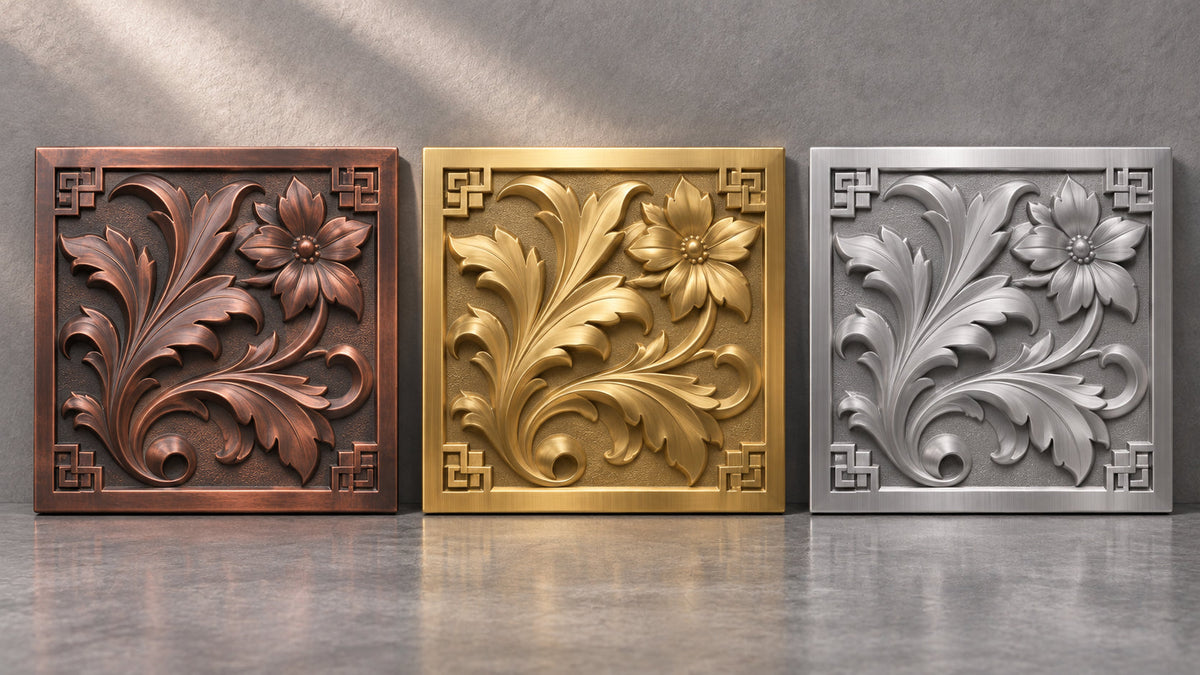
Copper, brass, and aluminum can all be used for custom metal relief signs, but each offers different advantages. Copper is well suited to antique and blackened effects, brass offers a wider range of decorative metallic finishes, and aluminum provides a lighter alternative with versatile surface treatments. The right choice depends on appearance, weight, installation environment, and maintenance expectations.
1. What Are the Key Differences Between Copper, Brass, and Aluminum Relief Signs?
Metal relief signs use raised and recessed surfaces to create dimensional artwork, decorative patterns, or architectural branding. Material selection affects the finished relief's appearance, weight, surface treatment, and long-term behavior.
Copper, brass, and aluminum are three available options, but they should not be treated as interchangeable.
Copper is naturally reddish and is particularly suitable for reliefs with aged or blackened appearances. Brass is a copper-zinc alloy with a naturally warm yellow or golden tone, making it useful for decorative metallic finishes. Aluminum is naturally silver-gray and significantly lighter than either material.
The following table summarizes the main differences.
| Feature | Copper | Brass | Aluminum |
|---|---|---|---|
| Natural Color | Reddish-orange | Yellow-gold | Silver-gray |
| Typical Density | Approx. 8.96 g/cm³ | Approx. 8.4–8.7 g/cm³ | Approx. 2.70 g/cm³ |
| Available Finishes | Antiqued, blackened | Brushed, mirror-polished, antiqued, blackened, baked-painted | Brushed, antiqued, blackened, baked-painted, Spray-Metallized, anodized |
| Natural Aging | Oxidation and possible patina development | Tarnishing and surface darkening | Natural oxide formation |
| Weight Consideration | Relatively heavy | Relatively heavy | Significantly lighter |
| Main Selection Advantage | Aged and darkened copper character | Decorative metallic appearance and finish variety | Lower weight and flexible surface finishes |
The listed finishes reflect LC Sign's available surface-treatment options. Their suitability for a specific relief depends on the material grade, shape, dimensions, and required appearance.
Material selection should therefore consider the intended finished result rather than the untreated metal color alone.
2. How Do Copper, Brass, and Aluminum Differ in Appearance and Finishing Options?
Appearance is often the deciding factor in decorative metal reliefs.
Raised surfaces, recessed details, and changing light angles make the material's color and surface texture particularly noticeable. Finishing choices can emphasize these details or create a more uniform architectural appearance.
Copper: Aged and Blackened Decorative Effects
Copper has a natural reddish-orange color, but it can also be treated to create darker, aged appearances.
For LC Sign's copper reliefs, the main finishing options are:
- Antiqued Finish: Creates an intentionally aged appearance, often emphasizing variations between raised and recessed areas.
- Blackened Finish: Produces a darker surface effect that can give the relief a more subdued appearance.
These treatments are useful when the design calls for an aged metal character rather than a bright, newly polished surface.
Depending on the approved finish, variations in tone may also help emphasize the relief's texture and dimensional details.
However, an intentionally antiqued finish should not be confused with natural outdoor weathering. The resulting color and texture depend on the finishing process, while subsequent surface changes depend on environmental exposure and any protective treatment.
Brass: Decorative Metallic Finishes
Brass has a naturally warm yellow-gold color, making it a useful option for decorative metal reliefs that require a distinctive metallic appearance.
LC Sign offers several brass finishing options:
- Brushed: Produces a directional grain texture with a softer, less reflective appearance.
- Mirror-Polished: Creates a highly reflective surface that emphasizes the metallic color.
- Antiqued: Produces an aged appearance with darker or varied tones.
- Blackened: Creates a dark decorative finish.
- Baked-Painted: Provides an applied painted finish for specified decorative colors.
These options allow brass to be used for different visual styles, from polished architectural details to darker decorative reliefs.
For example, brushed brass may suit a design requiring a restrained golden finish, while mirror-polished brass may be selected when stronger reflections are intentional.
Antiqued and blackened finishes can produce substantially different appearances from untreated brass.
The finished result should therefore be evaluated using the specified surface treatment, not merely the material name.
Aluminum: Lightweight Material with Versatile Finishing Options
Aluminum has a naturally silver-gray appearance and supports several decorative finishing methods.
LC Sign's aluminum relief finishing options include:
- Brushed: Creates a visible directional metal texture.
- Antiqued: Produces an intentionally aged decorative appearance.
- Blackened: Creates a dark surface effect.
- Baked-Painted: Provides a specified painted color.
- Spray-Metallized: Creates a decorative metallic coating effect.
- Anodized: Produces an electrochemically formed oxide finish on suitable aluminum materials.
These options make aluminum worth considering when the relief must coordinate with a particular architectural color or decorative theme.
For example, a coated aluminum relief may reproduce certain copper-like or brass-like appearances without using those metals as the base material.
However, a decorative metallic coating does not have the same physical properties or natural aging behavior as solid copper or brass.
The suitability of anodizing and other finishes should also be confirmed for the selected aluminum alloy and relief construction.
The important distinction is whether the project requires the natural character of a particular metal or a specified surface appearance that can be achieved through finishing.
Explore the available metal finishes for custom signage, including brushed, polished, antiqued, blackened, and coated finishes.
3. How Do Weight and Size Affect Material Selection?
Weight becomes increasingly important as the size of a metal relief increases.
Copper and brass are substantially denser than aluminum. For the same material volume, copper weighs approximately 3.3 times as much as aluminum, while brass typically weighs around 3.1–3.2 times as much, depending on its composition.
Copper and brass are relatively close in density, so changing from one to the other does not usually provide a major weight reduction.
When Is Aluminum Worth Considering?
Aluminum is often a practical starting point for large reliefs where reducing material weight is important.
This may include architectural feature walls, extensive decorative panels, or raised-metal designs installed on supporting surfaces with weight restrictions.
Its lower density can reduce the weight of the metal components while allowing the designer to select from several decorative finishes.
If a large relief requires a copper-colored or brass-colored appearance but does not require those metals as the actual material, a suitably finished aluminum construction may be worth evaluating.
However, lower density does not eliminate the need for structural consideration.
A large aluminum relief may still require reinforcement, a supporting frame, or other components that add to its overall weight.
When Should Buyers Consider Copper or Brass?
Copper or brass may be appropriate when the authentic base-metal appearance is an important design requirement.
For instance, a project specifying genuine brushed brass may not be satisfied by an aluminum coating intended to resemble brass.
Similarly, a copper relief with an intentional aged or blackened finish may be selected for its material character.
For smaller decorative pieces, the weight difference may be less significant than the desired appearance.
It is also important to remember that reliefs may use different constructions. Solid, hollow, formed, and assembled reliefs can have very different finished weights, even when their external dimensions are similar.
Buyers should compare the estimated weight of complete relief assemblies rather than relying on material density alone.
4. Which Material Is Better for Outdoor Reliefs and Long-Term Maintenance?
Copper, brass, and aluminum can all be considered for outdoor decorative reliefs, but their long-term appearance depends on the environment and surface treatment.
No single material or finish is suitable for every installation.
Copper: Surface Oxidation and Finish Changes
Copper naturally reacts with its environment.
Untreated surfaces may gradually darken, and prolonged exposure under suitable conditions can produce characteristic patina.
For antiqued or blackened copper reliefs, the long-term appearance depends on the finishing treatment, any protective layer, and the installation environment.
If the project requires a particular darkened appearance to remain visually consistent, the treatment and maintenance expectations should be clarified.
The buyer should not assume that an intentionally aged copper finish will remain unchanged outdoors.
Brass: Maintaining the Intended Decorative Appearance
Brass can gradually tarnish or darken through environmental exposure.
This is especially relevant when the desired effect depends on a polished or brushed metallic appearance.
Mirror-polished brass may require more attention to fingerprints, marks, and changes in reflectivity than a darker decorative finish.
Antiqued and blackened brass may be selected when a darker appearance is intentional, but their long-term behavior still depends on the treatment and exposure conditions.
Baked-painted brass introduces different maintenance considerations associated with the applied coating.
For exterior applications, the specified finish should be evaluated for the expected environment rather than assuming every available decorative treatment has identical outdoor performance.
Aluminum: The Importance of Finish Selection
Aluminum naturally forms an oxide layer that helps protect the underlying material.
Additional surface treatments may provide decorative color and enhanced surface performance when properly specified.
Anodized, baked-painted, Spray-Metallized, brushed, antiqued, and blackened finishes do not necessarily offer the same weathering behavior.
For example, a coating intended primarily for decorative appearance should not automatically be assumed to meet demanding exterior durability requirements.
The selected finish, material grade, surface preparation, and installation environment all matter.
What About Coastal and High-Moisture Environments?
Outdoor reliefs exposed to salt, moisture, or industrial pollutants require additional consideration.
Connections between dissimilar metals, moisture trapped behind components, and unsuitable surface treatments can contribute to deterioration.
Copper runoff may also stain adjacent materials in certain conditions.
For all three metals, buyers should confirm that the proposed finish and complete assembly are appropriate for the installation environment.
The better outdoor material is the one whose specified finish and construction meet the project's appearance, exposure, and maintenance requirements.
5. Which Material Should You Choose for Different Relief Applications?
Material selection becomes easier when the project's design priorities are clearly defined.
The following table provides a practical starting point for comparing copper, brass, and aluminum reliefs.
| Project Priority | Material to Consider First | Reason |
|---|---|---|
| Authentic aged reddish-copper appearance | Copper | Natural copper base with antiqued finishing options |
| Darkened copper relief | Copper | Available blackened treatment |
| Natural golden metallic appearance | Brass | Characteristic brass color |
| Brushed golden decorative finish | Brass | Available brushed brass treatment |
| Highly reflective gold-toned metallic finish | Brass | Available mirror-polished finish |
| Large relief with weight constraints | Aluminum | Significantly lower material density |
| Specific painted architectural color | Brass or Aluminum | Available baked-painted finishes |
| Copper-like or brass-like appearance with lower material weight | Finished Aluminum | Decorative coatings can reproduce certain metallic effects |
| Lightweight relief with an anodized surface | Aluminum | Anodizing is available for suitable aluminum materials |
| Dark decorative relief without a requirement for a particular base metal | Copper, Brass, or Aluminum | Compare actual finish samples and construction requirements |
The recommended materials are starting points, not fixed rules.
A darker decorative relief, for example, may be achievable using all three materials. The choice then depends on the required surface texture, weight, exposure conditions, and whether the base-metal identity matters.
Likewise, aluminum may be a practical choice for a large architectural relief, but genuine brass may still be preferred if the design specifically calls for its natural golden appearance.
What Should Buyers Prioritize?
Three questions can help narrow the decision:
- Appearance: Does the project require the natural appearance of copper or brass, or a particular decorative finish?
- Weight: Will material density significantly affect the proposed relief size and installation?
- Long-Term Performance: How should the surface look after exposure, and what maintenance will be acceptable?
When the exact finish is important, comparing representative samples of the intended materials and treatments is more useful than relying on material names or digital color references alone.
The final selection should balance the intended visual result with the practical requirements of the installation.
Conclusion
Copper, brass, and aluminum offer different advantages for decorative and architectural relief signs.
Copper is particularly suitable for designs requiring aged or blackened copper effects. Brass provides a naturally warm metallic appearance with options including brushed, mirror-polished, antiqued, blackened, and baked-painted finishes. Aluminum offers substantially lower material weight and a broad selection of decorative surface treatments.
The most suitable material depends on the required appearance, relief size, installation environment, and expectations for long-term surface maintenance.
Rather than selecting solely by material name, buyers should consider the actual finish and construction proposed for their project.
Planning a custom metal relief project? Share your design, dimensions, and preferred surface finish with LC Sign to compare suitable copper, brass, and aluminum options.
Frequently Asked Questions
What Is the Main Difference Between Copper and Brass Relief Signs?
Copper has a naturally reddish appearance, while brass is a copper-zinc alloy with a typically yellow-gold color. LC Sign primarily offers antiqued and blackened finishes for copper reliefs, while brass supports brushed, mirror-polished, antiqued, blackened, and baked-painted finishes. The better choice depends on the desired appearance rather than assuming one material is universally superior.
Can Aluminum Reliefs Be Finished to Look Like Copper or Brass?
Yes. Decorative finishing methods can produce copper-like or brass-like appearances on aluminum. However, the resulting coating does not have the same material composition or natural aging behavior as genuine copper or brass. Buyers should review a representative finish sample when an exact metallic appearance is important.
Is Aluminum Better for Large Metal Reliefs?
Aluminum is often worth considering for large reliefs because it has a substantially lower density than copper or brass. This can reduce material weight, but the finished assembly may still require structural supports. The final choice should consider appearance, construction, mounting conditions, and the estimated total weight.
Can Copper, Brass, and Aluminum Reliefs Be Used Outdoors?
All three can be considered for outdoor applications when the material, finish, and construction are suitable for the installation environment. The available decorative treatments do not automatically have identical weather resistance. Buyers should confirm exterior suitability and expected maintenance for the specific finish.
Which Metal Relief Material Requires the Least Maintenance?
There is no universal answer. Maintenance depends on whether the relief uses a natural metal surface, an antiqued or blackened treatment, a polished finish, or a protective decorative coating. The intended appearance and environmental exposure are often more important than the base-metal name alone.
Recommended reading
Flat-Cut vs. Fabricated Metal Letters: Which Is Right for Your Sign?
How to Choose the Right Metal Finish for Custom Signs
How to Choose the Right Mini LED Letters for Your Signage Project
Can Any Logo or Font Be Made into Channel Letters? Design & Fabrication Limits
Recommended products
LC-XFL02 · LED Frontlit Rimless Letters & Signs