

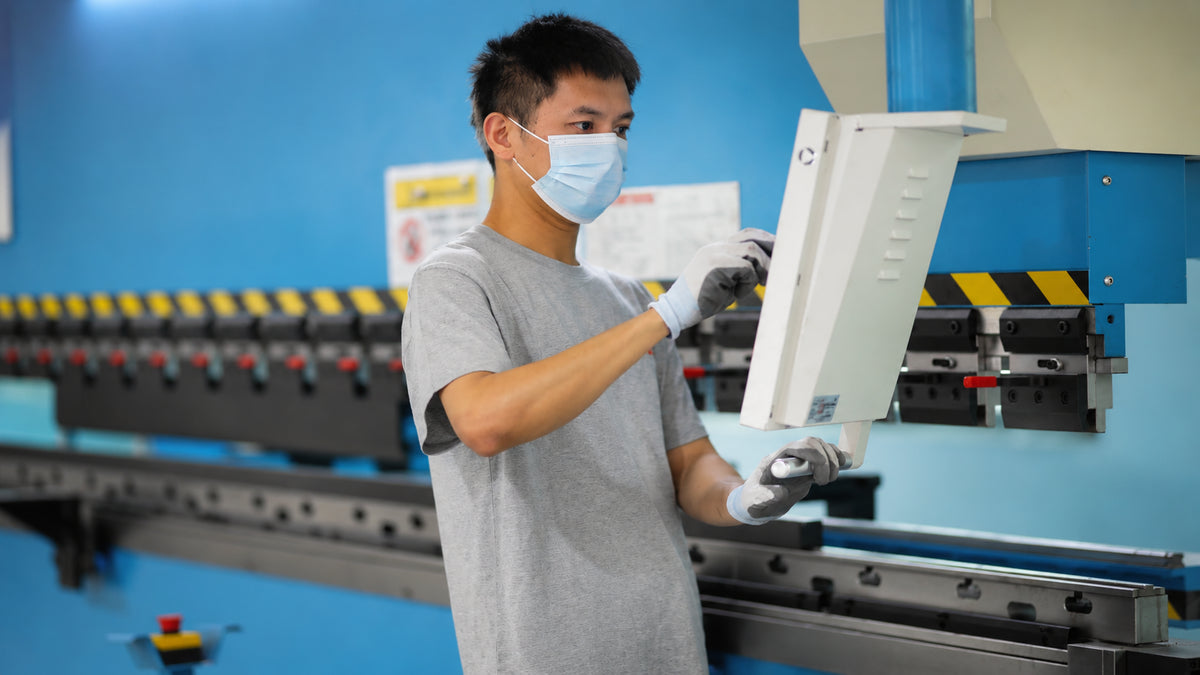
Buyers can verify a sign manufacturer's in-house capabilities by reviewing its production facilities, equipment, manufacturing processes, workforce, and evidence of completed orders. Factory visits, live video walkthroughs, product-specific demonstrations, and production records can help confirm whether the supplier performs the claimed manufacturing operations or relies on external production partners.
1. What Does In-House Sign Manufacturing Actually Mean?
In-house manufacturing means that a company performs defined fabrication or production processes within facilities it operates. It does not necessarily mean that every component or specialized process is completed at the same factory.
Custom sign manufacturing may involve metal fabrication, acrylic processing, surface finishing, graphic production, electrical assembly, and final product assembly. These processes require different equipment and technical skills.
Manufacturers may organize these activities differently.
| Manufacturing Model | How It Operates | What Buyers Should Verify |
|---|---|---|
| In-House Manufacturing | Core fabrication and production processes are performed at the manufacturer's facilities | Which processes and product categories are produced internally |
| Outsourced Manufacturing | Products or major components are produced by external suppliers | Who performs the work and manages specifications |
| Assembly-Based Operations | Components are sourced externally and assembled or finished by the company | Which manufacturing stages are completed on-site |
| Hybrid Manufacturing | Internal production is combined with selected outsourced processes | How production responsibility and quality control are divided |
These models are not necessarily indicators of good or poor quality.
For example, a manufacturer may produce metal cabinets and acrylic components internally while outsourcing a specialized surface treatment. Another company may source complete sign components and handle only final assembly.
Both businesses may supply finished signage, but their direct manufacturing capabilities are different.
The important question is which processes the manufacturer actually controls and whether those capabilities match the products being purchased.
2. What Equipment and Production Facilities Should Buyers Verify?
Equipment verification should focus on whether the manufacturer has the machinery, facilities, and skilled personnel required for the buyer's specific signage products.
A factory with many machines is not automatically capable of producing every type of custom sign.
For example, channel letters, illuminated lightboxes, architectural plaques, and large pylon signs have different fabrication requirements.
The following table provides a starting point for reviewing production capabilities.
| Production Area | Equipment or Facilities to Check | Relevant Manufacturing Tasks |
|---|---|---|
| Metal Cutting | Fiber laser cutting equipment | Metal letter components, cabinets, structural parts |
| Metal Forming | Bending, V-grooving, and forming equipment | Letter returns, metal profiles, cabinet components |
| Welding | TIG, laser welding, or other appropriate welding equipment | Metal assemblies and fabricated structures |
| Acrylic Processing | CNC routers and laser cutting equipment | Acrylic faces, dimensional components, custom shapes |
| Surface Finishing | Grinding, polishing, brushing, and finishing facilities | Surface preparation and decorative finishes |
| Graphic Production | UV printing and other relevant printing equipment | Logos, printed faces, and graphic elements |
| Assembly | Product assembly workstations and electrical tools | Lighting installation, wiring, and final assembly |
The relevant equipment depends on the product. Not every manufacturer needs every machine listed above.
How Can Buyers Confirm That the Equipment Is Actually Used?
During a factory visit or live video tour, ask to see the equipment performing work related to the products you intend to purchase.
Useful questions include:
- What materials can the equipment process?
- What types and dimensions of components are regularly produced?
- Can the manufacturer demonstrate a comparable production task?
- Are trained operators available?
- How do components move from one production stage to another?
A machine's presence confirms that equipment is available at the site, but it does not independently prove production experience, capacity, or consistent manufacturing performance.
For a more detailed explanation of cutting, forming, welding, finishing, and graphic production technologies, refer to Essential Equipment for Sign Manufacturing: A Guide to the Technologies Behind Professional Sign Production.
Understanding the relationship between equipment and manufacturing processes can help buyers ask more specific questions during factory verification.
3. How Can Buyers Verify the Actual Production Process?
A reliable factory assessment should examine real manufacturing activities rather than relying only on equipment lists, showroom samples, or completed product photographs.
The most useful approach is to follow a representative product through its main production stages.
For example, when evaluating a manufacturer of illuminated channel letters, buyers may ask to observe:
- Material preparation: How metal and acrylic components are prepared for fabrication.
- Component fabrication: How letter shapes, returns, and backs are cut and formed.
- Assembly: How fabricated components are fitted and joined.
- Electrical integration: How LEDs, wiring, and power connections are incorporated.
- Final inspection: How the finished product is checked against approved specifications.
For other products, the relevant workflow will differ.
A lightbox may require cabinet assembly, face preparation, and lighting integration. A large pylon structure may involve different metal fabrication and structural assembly processes.
The purpose is not to require every manufacturing stage to be observed in one visit. It is to establish that the factory performs the claimed operations and can explain how they are coordinated.
What Should Buyers Look for During a Production Walkthrough?
Pay attention to how materials, components, workstations, and production teams are organized.
Useful observations include whether operators understand their assigned processes, whether the equipment is relevant to the products being manufactured, and whether the factory can explain how production specifications are communicated between departments.
Ask to see a current production order where commercially appropriate, with confidential customer information concealed.
A genuine factory walkthrough should provide evidence of actual work, not simply a tour of machines and finished products.
For buyers evaluating a particular product category, more specialized criteria may also be useful. The guide to evaluating a channel letter manufacturer's production capabilities explains what to examine when purchasing custom illuminated letters.
4. How Can Buyers Distinguish In-House Production from Outsourced Work?
Outsourcing is not necessarily a problem in custom sign manufacturing. Certain processes may require specialized equipment, certifications, or expertise that a manufacturer does not maintain internally.
The concern arises when a supplier cannot clearly explain where production takes place or who is responsible for externally manufactured components.
Buyers should establish the boundary between internal and outsourced work before committing to a significant order.
| Question to Ask | Evidence or Explanation to Request |
|---|---|
| Which production processes are completed in-house? | Production departments, facilities, and relevant equipment |
| Which components or processes are outsourced? | Clear identification of externally completed work |
| Who confirms outsourced component specifications? | Technical review and approval responsibilities |
| Who manages the external supplier's progress? | Defined coordination and production responsibilities |
| Who inspects outsourced components? | Receiving or component inspection arrangements |
| Who takes responsibility for the finished order? | Contractual, quality, and delivery responsibilities |
Why Does Outsourcing Transparency Matter?
The distinction becomes important when a project involves technical changes, quality issues, or production delays.
For example, if a specialized finish is outsourced, buyers should know who confirms the approved finish, checks the returned components, and resolves discrepancies.
A manufacturer does not need to own every production process to be a suitable supplier. However, it should be able to explain how externally sourced work is integrated into the final product.
Clear responsibilities matter more than a blanket claim that everything is manufactured in-house.
5. How Can International Buyers Verify a Factory Remotely?
International buyers may not have the opportunity to visit a manufacturer before placing an order. Remote verification can provide useful evidence when it is structured around specific products and manufacturing activities.
Static photographs and promotional videos are a reasonable starting point, but they should not be treated as conclusive proof of production capacity.
More useful verification methods include:
| Verification Method | What It Helps Confirm | Main Limitation |
|---|---|---|
| Live Video Factory Tour | Facilities, equipment, and activities visible during the session | Does not prove overall production capacity |
| Live Equipment Demonstration | Operation of specific equipment | Only demonstrates the observed task |
| Production Videos | Relevant fabrication methods and workflows | May be prerecorded or selective |
| Similar Project Records | Experience with comparable products | Does not necessarily prove in-house production |
| Physical Sample | Ability to deliver a product matching specifications | Does not establish where every component was made |
| Production Progress Records | Evidence of work on an agreed order | Requires reliable identification of the order and stages |
How Should Buyers Conduct a Live Video Verification?
Before scheduling the call, identify the two or three production processes most relevant to your project.
Ask the manufacturer to show those workstations, demonstrate a relevant operation where practical, and explain how components move between production stages.
It may also be useful to request a live walkthrough from the fabrication area to the assembly area, rather than viewing isolated machines.
Where appropriate, buyers can ask to see a current product or component that resembles their intended order.
A factory that cannot demonstrate a specific process during a single call is not automatically unreliable. The relevant machine may be unavailable, undergoing maintenance, or scheduled for other production.
In such cases, request alternative evidence and clarify whether the process is performed internally or externally.
For larger orders or higher-risk purchases, an independent factory audit may provide additional assurance. The scope of such an audit should match the capabilities and risks the buyer needs to verify.
6. What Evidence Should Buyers Request Before Choosing a Sign Manufacturer?
The strongest factory assessment combines different forms of evidence rather than relying on one impressive showroom, equipment list, or demonstration.
Buyers should request evidence relevant to the products and order requirements they intend to purchase.
| Evidence to Request | What It Should Help Verify |
|---|---|
| Factory Overview | Location, production areas, and operating departments |
| Relevant Equipment Information | Availability of equipment needed for the intended products |
| Live Production Demonstration | Actual operation of selected manufacturing processes |
| Similar Project Examples | Experience with comparable products and specifications |
| Production Workflow Explanation | How fabrication, assembly, and other stages are coordinated |
| Workforce and Technical Support | Availability of personnel for relevant processes |
| Outsourcing Disclosure | Which processes or components are externally sourced |
| Sample or Production Records | Ability to execute agreed product specifications |
| Manufacturing Responsibility | Who controls the work and accepts responsibility for the finished order |
How Should Buyers Evaluate the Evidence?
A practical assessment can be completed in four steps.
-
Identify the required manufacturing processes.
Determine which fabrication, finishing, assembly, and electrical processes are necessary for your product. -
Request evidence for those processes.
Focus on relevant production activities rather than asking for every available factory document. -
Clarify gaps and outsourced activities.
Where evidence is incomplete, ask whether the process is performed internally, outsourced, or not currently supported. -
Compare the findings with your project requirements.
Determine whether the manufacturer can support the required product specifications, quantity, and production arrangements.
Evidence should be proportionate to the purchasing risk. A small sample order may not require the same depth of verification as a large, recurring manufacturing contract.
The objective is not to collect the largest number of photographs or documents. It is to establish a reasonable, evidence-based understanding of what the manufacturer can actually produce.
Conclusion
Verifying a sign manufacturer's in-house capabilities requires more than reviewing its factory size, equipment list, or product catalog.
Buyers should examine the manufacturing processes relevant to their projects, request evidence of actual production, and clarify which activities are completed internally or outsourced.
Factory visits, live demonstrations, production records, and samples can provide complementary evidence. Together, they help buyers make more informed decisions about a manufacturer's suitability before placing an order.
Frequently Asked Questions
How Can I Tell If a Sign Manufacturer Is a Real Factory?
Check whether the company operates identifiable production facilities and can demonstrate manufacturing processes relevant to the products it supplies. Live factory tours, equipment demonstrations, production records, and comparable project examples can provide supporting evidence. A business registration or factory photograph alone does not prove the full scope of its manufacturing capabilities.
Does a Sign Manufacturer Need to Own All Its Production Equipment?
No. A manufacturer may own its core equipment while using external specialists for selected processes. What matters is whether it has the relevant capabilities for the required products and clearly identifies which operations are completed internally or outsourced.
Is Outsourcing Part of Sign Manufacturing a Red Flag?
Not necessarily. Outsourcing specialized processes can be a practical manufacturing arrangement. Buyers should focus on transparency, technical coordination, component inspection, and responsibility for the completed order. Undisclosed outsourcing or unclear accountability requires closer investigation.
How Can I Verify a Chinese Sign Manufacturer Without Visiting the Factory?
Request a live video walkthrough, demonstrations of relevant equipment, examples of comparable products, and supporting production records. Ask questions about specific fabrication processes rather than relying only on promotional materials. For higher-risk orders, consider an independent factory audit.
What Should I Check During a Sign Factory Visit?
Focus on production equipment relevant to your project, actual fabrication activities, operator expertise, workflow organization, assembly processes, and evidence of comparable orders. Also clarify which processes are performed on-site and which are outsourced. The visit should establish whether the factory's demonstrated capabilities match your intended products.
Recommended reading
How to Choose a Custom Sign Manufacturer: What B2B Buyers Should Evaluate
What Should Buyers Look for in a Sign Manufacturer's Quality Control Process?
How to Choose the Right Mini LED Letters for Your Signage Project
How to Choose the Right Metal Finish for Custom Signs
Recommended products
LC-XFL02 · LED Frontlit Rimless Letters & Signs