

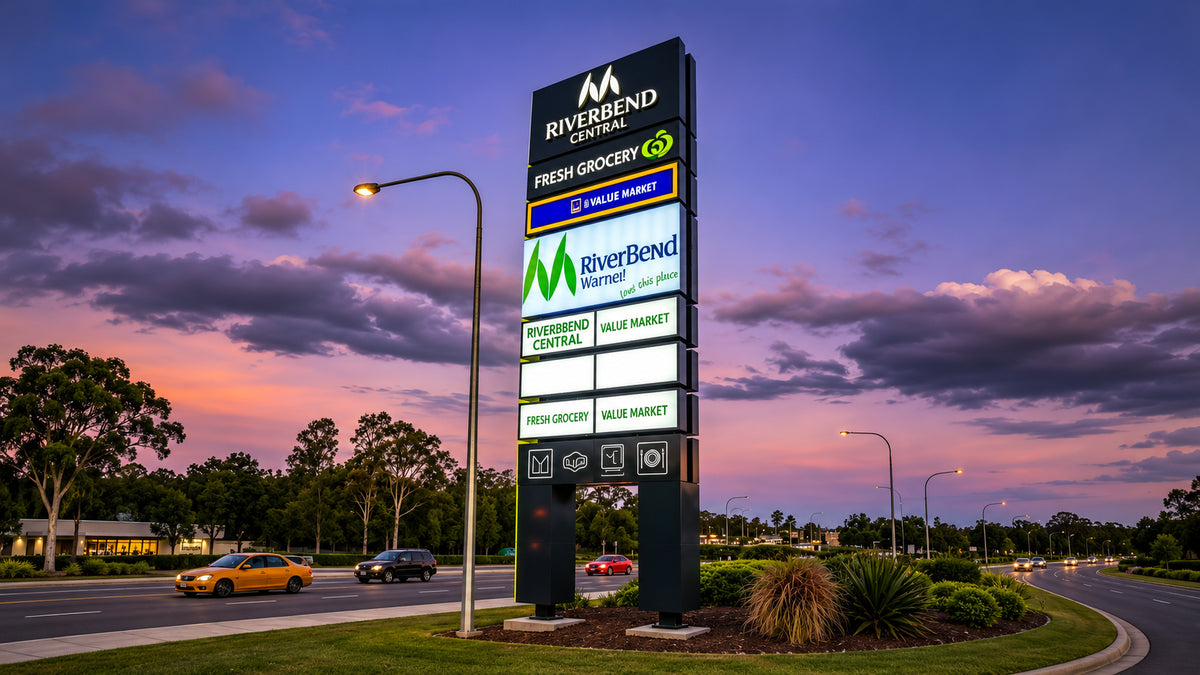
Choosing a pylon sign for a commercial property requires evaluating viewing distance, sign dimensions, display configuration, tenant information, illumination, and site conditions. The right specifications depend on how visitors approach the property, how much information the sign needs to display, and the physical and regulatory requirements of the installation location.
For buyers still evaluating different commercial signage options, our guide to choosing the right commercial sign for your business provides a broader comparison of signage solutions and their applications.
1. How Should You Determine the Height and Size of a Pylon Sign?
Pylon sign dimensions should be determined by the property's visibility requirements, available installation space, and applicable sign regulations. A taller sign is not necessarily more effective if its display is poorly positioned or difficult to read.
Several factors should be evaluated before establishing the dimensions.
Viewing Distance
The sign should be large enough for its intended audience to recognize the property and read the information it displays. A sign intended for approaching drivers may require different letter sizes and display proportions from one positioned near a property entrance.
Road Traffic and Approach Direction
The direction and speed of approaching traffic influence how much information can be communicated effectively. Drivers approaching at higher speeds generally have less time to identify a property and read individual tenant names. This makes clear visual hierarchy and concise messaging particularly important.
Building Setback and Surrounding Obstructions
Properties positioned far from the road may need an elevated sign to maintain visibility. Nearby buildings, trees, parked vehicles, and other signs can also affect the available viewing area.
Available Sign Area and Local Restrictions
The overall sign dimensions must fit the available installation space and comply with local requirements for sign height, display area, setbacks, and placement.
Rather than selecting dimensions based on a standard template, buyers should evaluate the actual site and viewing conditions before finalizing the design.
2. Should You Choose a Single-Sided or Double-Sided Pylon Sign?
The choice between single-sided and double-sided pylon signs depends primarily on traffic direction, sign orientation, and the number of viewing approaches that need to be served.
| Configuration | Suitable Conditions | Main Consideration |
|---|---|---|
| Single-Sided | Primary viewing traffic approaches from one direction | Display orientation and unobstructed visibility |
| Double-Sided | Traffic approaches from opposite directions | Visibility from both sides and structural configuration |
Single-Sided Pylon Signs
A single-sided sign displays information on one face. It may be suitable for properties where the primary traffic approach is clearly defined and the sign can be positioned to face incoming visitors.
This configuration can also work where the property has a specific entrance orientation or where visibility from the opposite direction is not required.
Double-Sided Pylon Signs
A double-sided sign presents information on two opposing faces, allowing visitors approaching from different directions to see the display.
This configuration is commonly considered for roadside locations, divided traffic approaches, and commercial properties with visibility requirements from multiple directions.
However, double-sided construction should not be selected automatically. Buyers should first assess whether both faces will have useful viewing exposure and whether the additional structural and electrical requirements are justified.
The final decision should account for road layout, traffic flow, sign positioning, and the property's entrance location.
3. How Should You Plan Tenant Panels and Display Layouts?
For multi-tenant commercial properties, tenant panel planning is one of the most important parts of pylon sign design. The objective is to organize business names and logos so visitors can identify the property and locate individual tenants without making the display difficult to read.
Determine the Number of Tenant Panels
Start by confirming how many businesses need to be displayed. The available sign area should accommodate the required information without forcing individual panels to become too small.
For shopping centers and commercial plazas, buyers should also consider whether additional tenant spaces may be occupied in the future.
Establish a Clear Information Hierarchy
The property name, major tenant identities, and individual business names may have different levels of importance.
A clear layout should establish this hierarchy through panel positioning, typography, logo proportions, and spacing. Giving every tenant identical visual prominence is not always the most effective solution, particularly when the development has a main anchor tenant or an established property identity.
Consider Modular Panel Configurations
A modular arrangement can make future tenant changes easier to manage.
Where appropriate, individual tenant panels can be designed as replaceable components rather than requiring the entire sign face to be reconstructed whenever a business changes its branding or occupancy.
However, replaceability depends on the cabinet design, panel retention method, access provisions, and electrical arrangement.
Allow for Different Logo Proportions
Tenant logos may have very different shapes and aspect ratios. A layout designed only around uniform text lines may not accommodate all brand identities effectively.
Artwork should be reviewed before panel dimensions and graphic arrangements are finalized.
A well-planned multi-tenant pylon sign should balance tenant visibility, property identification, and future flexibility within the available display area.
4. Which Lighting and Display Configuration Fits Your Project?
The choice of display configuration depends on when the sign needs to be visible, what information it must communicate, and how frequently that information changes.
Non-Illuminated Displays
Non-illuminated pylon signs may be suitable for properties where daytime identification is the primary requirement and the surrounding environment provides sufficient visibility.
Their suitability depends on viewing conditions, graphic contrast, ambient lighting, and the property's operating hours.
Internally Illuminated Displays
Internally illuminated displays use integrated lighting to make sign faces more visible in low-light conditions and at night.
They are worth considering for commercial properties that operate after dark or require consistent identification during evening hours.
The lighting arrangement should provide appropriate illumination across the display without creating excessive brightness or unevenly lit areas.
Digital Displays
Digital displays can present changing information, promotional messages, or time-sensitive content. They may be useful for properties that require frequent updates rather than permanently fixed tenant information.
However, digital configurations introduce additional considerations, including display equipment, power requirements, content management, maintenance, and applicable local restrictions.
| Display Configuration | Best Suited To | Main Consideration |
|---|---|---|
| Non-Illuminated | Primarily daytime identification | Ambient visibility and graphic contrast |
| Internally Illuminated | Properties requiring nighttime visibility | Light distribution and electrical access |
| Digital Display | Frequently updated information | Equipment, content management, and operating requirements |
Buyers should select a display system according to the property's actual operating needs rather than assuming that more advanced lighting or display technology will always provide greater value.
5. What Structural and Site Requirements Should Be Evaluated?
Pylon signs are elevated structures, so their engineering requirements must be considered alongside the visual design. A sign that meets the desired appearance and display specifications still needs to be suitable for the installation site.
Foundation and Ground Conditions
Foundation requirements depend on the sign's dimensions, structural loads, soil conditions, and site characteristics. Buyers should identify available installation areas and relevant ground information before the engineering design is finalized.
Structural Support and Wind Exposure
The support structure must be designed for the project's applicable environmental loads, including wind exposure. Sign height, cabinet dimensions, exposed surface area, and site location all influence engineering requirements.
Structural calculations and foundation specifications should be prepared or reviewed by qualified professionals according to applicable local codes.
Underground Utilities and Site Access
Underground electrical services, drainage systems, water lines, and other utilities may restrict foundation placement.
The proposed location should also allow suitable access for installation equipment, construction work, and future maintenance.
Electrical Access and Maintenance Planning
Illuminated and digital signs require appropriate electrical infrastructure. Buyers should consider power availability, wiring routes, access to electrical components, and the practical arrangements for servicing the display.
Permits and Local Regulations
Before production, confirm applicable restrictions on sign height, area, placement, illumination, and structural design. Requirements vary by jurisdiction and property, so local approval conditions should be checked for each project.
These considerations should be reviewed before the sign dimensions and fabrication specifications are treated as final.
Buyers who need a broader understanding of available designs and structural options can explore different pylon sign types and structural configurations before finalizing their project specifications.
6. What Information Should You Prepare Before Ordering a Custom Pylon Sign?
Providing complete project information helps align the design, engineering, and manufacturing requirements before production begins.
The following checklist covers the main information buyers should prepare.
| Information to Prepare | Details to Provide |
|---|---|
| Project Location | Installation address and applicable local requirements |
| Site Information | Property layout, available installation space, and site photographs |
| Sign Dimensions | Proposed height, width, and available display area, if known |
| Viewing Conditions | Road direction, approach routes, viewing distance, and obstructions |
| Display Configuration | Single-sided or double-sided requirements |
| Tenant Information | Number of panels, business names, logos, and information hierarchy |
| Lighting Requirements | Non-illuminated, internally illuminated, or digital display |
| Installation Conditions | Ground information, underground utilities, and electrical access |
| Design References | Artwork, brand guidelines, reference images, and project drawings |
Not every buyer will have finalized engineering drawings or exact dimensions at the initial inquiry stage. Preliminary site photographs, property plans, branding materials, and a description of the intended application can still provide a useful starting point for design discussions.
Conclusion
Choosing a pylon sign involves coordinating visibility, dimensions, display layout, illumination, and site requirements. For multi-tenant properties, panel organization and future replacement flexibility are also important considerations.
By preparing the relevant site information and display requirements before production, buyers can establish more suitable specifications and reduce unnecessary design changes during project development.
Planning a custom pylon signs project? Contact LC Sign for custom quotes.
Frequently Asked Questions
How Tall Should a Pylon Sign Be for a Shopping Center?
There is no universal height requirement for shopping center pylon signs. The appropriate height depends on road setback, viewing distance, surrounding obstructions, available installation space, and local sign regulations. Buyers should evaluate the actual site and permitted dimensions before finalizing the design.
Is a Double-Sided Pylon Sign Better Than a Single-Sided Sign?
A double-sided sign is useful when traffic approaches from opposite directions and both faces have clear viewing exposure. A single-sided sign may be sufficient when the primary viewing direction is clearly defined. The choice should reflect actual traffic patterns and sign positioning rather than the assumption that two display faces are always better.
How Many Tenant Panels Can a Pylon Sign Accommodate?
The number of tenant panels depends on the permitted sign area, overall dimensions, viewing distance, and the amount of information each business needs to display. Adding more panels reduces the available space per tenant, so readability and information hierarchy should be considered before the layout is finalized.
Can Individual Tenant Panels Be Replaced Without Replacing the Entire Pylon Sign?
Yes, if the sign is designed with replaceable panel sections or an appropriate modular display arrangement. The feasibility depends on panel retention, cabinet construction, access provisions, and the electrical configuration of illuminated displays. These requirements should be specified during the design stage if future tenant changes are expected.
What Information Is Needed to Request a Custom Pylon Sign Quotation?
Buyers should provide the project location, available site information, approximate dimensions, display configuration, tenant artwork, lighting preferences, and expected quantity. Site photographs and preliminary drawings are also useful. If exact engineering specifications are not yet available, preliminary project information can help establish the initial design requirements.
Recommended reading
Channel Letters vs. Lightbox Signs: Which Is Right for Your Storefront?
What Determines the Cost of a Custom Pylon Sign?
How to Choose the Right Mini LED Letters for Your Signage Project
How to Choose the Right Metal Finish for Custom Signs
Recommended products
LC-XFL02 · LED Frontlit Rimless Letters & Signs