

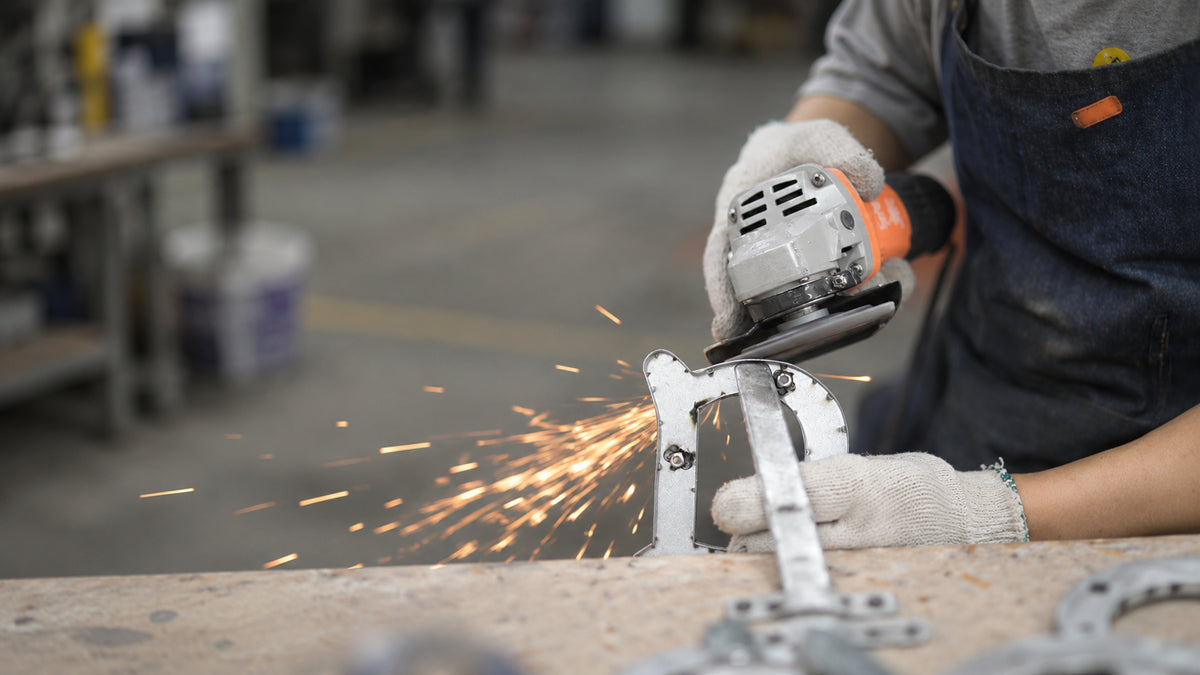
Metal fabrication methods affect the dimensional accuracy, edge quality, joint appearance, surface finish, and assembly of custom metal signs. Cutting, bending, welding, and finishing each influence different characteristics of the finished product. The results depend on material properties, product design, processing methods, and workmanship—not simply the equipment used.
1. How Does Cutting Affect the Accuracy and Edge Quality of Metal Signs?
Cutting establishes the shape and dimensions of metal components before they are formed or assembled. In custom sign manufacturing, this may involve stainless steel or aluminum letter faces, backs, cabinet panels, mounting components, and other fabricated parts.
Fiber laser cutting is commonly used for detailed metal profiles because it can produce complex outlines with controlled dimensions. However, cutting quality still depends on material thickness, machine settings, cutting conditions, and the geometry of the design.
Important characteristics include:
- Dimensional accuracy: Whether the cut component matches the approved drawing.
- Edge condition: Whether burrs, dross, or rough areas require additional processing.
- Shape accuracy: Whether curves, corners, and narrow sections retain their intended geometry.
- Flatness: Whether the component remains sufficiently flat for subsequent fabrication.
- Component fit: Whether adjoining parts can be assembled within the specified tolerances.
For example, a flat-cut stainless steel letter may have its edges directly exposed in the finished installation. In this case, the edge condition contributes to the final appearance.
For a fabricated channel letter, the cut face or back must also fit the formed metal returns. Even a relatively small dimensional discrepancy can create visible gaps or require adjustments during assembly.
Why Does Cutting Quality Matter Beyond Appearance?
Cutting errors can affect later production stages.
If a metal component is oversized, undersized, or distorted, additional trimming or fitting may be necessary. Poor edge preparation can also complicate joining and finishing.
A clean-looking cut is therefore only one part of the evaluation. The component must also meet the required dimensions and work correctly with the rest of the sign.
Different equipment used in professional sign manufacturing supports these operations, but the finished component should ultimately be evaluated against the approved specifications.
2. How Do Bending and Forming Affect Letter Shapes and Structural Accuracy?
Metal forming gives flat components their three-dimensional shapes. In signage manufacturing, bending is frequently used to create channel letter returns, fabricated metal letter sides, cabinet edges, and other profiles.
Accurate forming helps components follow the intended geometry and fit adjoining faces, backs, or panels.
For channel letters, the returns must follow the letter outlines while maintaining the required depth and alignment. A complex font with tight curves, narrow spaces, or sharp corners can be more difficult to form consistently than a simple geometric design.
Several factors influence the result:
Material properties and thickness
Different metals and thicknesses respond differently to forming. The selected process must account for the material's bending behavior, including springback and the risk of unwanted deformation.
Bend radius and corner geometry
The achievable bend radius depends on the material, thickness, tooling, and forming method. A very tight corner may require a different fabrication approach rather than simply increasing bending force.
Dimensional consistency
The formed component should retain the intended height, depth, and outline. Inconsistent forming can create difficulties when fitting letter faces or assembling cabinets.
What Happens When Formed Components Do Not Fit Correctly?
For fabricated dimensional letters, poorly formed returns may cause gaps, uneven edges, or visible differences between otherwise identical letters.
In metal lightbox cabinets, inaccurate forming can affect panel alignment and the fit of removable faces or access components.
These issues may sometimes be corrected during assembly, but excessive adjustment can increase manufacturing work and create additional finishing requirements.
The most suitable forming method is therefore the one that achieves the required geometry and tolerances for the specific material and construction—not necessarily the method that produces the sharpest-looking bend.
3. How Does Welding Influence Joint Quality and Finished Appearance?
Welding joins metal components into completed letters, cabinets, frames, and other signage structures. Depending on the materials and construction, manufacturers may use TIG, MIG, laser welding, or other suitable joining methods.
The choice of process depends on factors such as material type, thickness, joint design, accessibility, and required performance.
For custom signs, welding can influence both the physical integrity of the assembly and the appearance of visible joints.
What Determines the Quality of a Welded Joint?
Several factors matter:
- Joint preparation: Components should be appropriately fitted and prepared before joining.
- Welding process: The method and parameters should suit the material and joint requirements.
- Distortion control: Heat input, fixturing, and welding sequence can affect the final shape.
- Weld condition: The completed joint should meet the specified workmanship and performance requirements.
- Post-weld treatment: Cleaning, grinding, blending, or other finishing may be required depending on the material and design.
For fabricated metal letters, joints may be located where the returns meet or where separate components are connected.
If these joints remain visible, their appearance can affect the finished sign, particularly when it is viewed at close range.
However, a visually smooth joint is not automatically a sound joint. Conversely, a visible weld is not necessarily a defect.
The acceptance criteria should reflect the product's intended construction and applicable requirements.
Can Welding Cause Metal Sign Components to Warp?
Yes. Welding introduces localized heat, and uneven heating and cooling can cause distortion.
Thin metal panels, narrow letter returns, and long fabricated sections may be particularly sensitive to unwanted movement.
Appropriate joint design, fixturing, welding sequence, and process control can help manage this risk.
For metal sign cabinets or fabricated letter bodies, dimensional checks after joining can help identify whether the assembly remains within the specified tolerances.
Structural signage components may also require engineering-defined joining requirements and inspections. Visual appearance alone is not sufficient to establish structural performance.
4. How Do Grinding, Polishing, and Surface Preparation Affect the Final Finish?
Surface finishing influences how a metal sign looks and how well subsequent finishes can be applied.
After cutting, forming, and joining, components may require deburring, grinding, polishing, brushing, cleaning, or other surface preparation.
These operations serve different purposes.
Grinding and deburring can remove unwanted burrs, sharp edges, or excess material where specified.
Polishing can refine surface smoothness and appearance, depending on the intended finish.
Brushing creates a directional surface texture commonly used for decorative stainless steel letters.
Surface preparation before coating helps establish the substrate condition required by the selected coating system.
The process should be chosen according to the specified result rather than applied uniformly to every metal sign.
Why Does Surface Preparation Affect Appearance Consistency?
Consider a set of brushed stainless steel letters.
If the brushing direction or texture varies between letters, those differences may become visible when the signs are installed together.
For painted metal signs, uneven preparation or remaining surface contamination may affect the coating's appearance or adhesion.
Welded components may also require local finishing so that treated areas match the surrounding surfaces, where a blended appearance is specified.
However, finishing cannot always compensate for earlier fabrication defects. Significant dimensional errors, poor component fit, or excessive distortion may require correction before surface finishing.
Color consistency is a related but separate manufacturing consideration. Our article on how color consistency is controlled during sign manufacturing explains how approved references, substrates, coatings, and production conditions influence the finished appearance.
5. How Do Fabrication Requirements Differ Across Metal Sign Types?
The importance of each fabrication method depends on the sign's construction.
A flat-cut metal letter has different manufacturing requirements from a hollow fabricated letter or an illuminated cabinet.
The following table shows common relationships between product types, fabrication processes, and quality characteristics.
| Sign Type | Typical Fabrication Processes | Quality Characteristics to Evaluate |
|---|---|---|
| Flat-Cut Metal Letters | Profile cutting, deburring, surface finishing | Outline accuracy, cut edges, flatness, finish |
| Fabricated Metal Letters | Cutting, forming, joining, finishing | Letter geometry, joint condition, face and return alignment |
| Channel Letter Bodies | Cutting, return forming, joining, assembly | Return accuracy, component fit, consistent depth |
| Metal Lightbox Cabinets | Cutting, forming, joining, cabinet assembly | Dimensions, panel alignment, access openings, assembly |
| Pylon Sign Components | Cutting, forming, welding, component assembly | Fabrication accuracy, specified connections, alignment |
The actual fabrication sequence varies with product design, material, and construction.
Why Should Buyers Evaluate Fabrication According to the Product?
For flat-cut metal letters, the accuracy of the outline and quality of exposed edges may be among the most noticeable characteristics.
For fabricated dimensional letters, the joining and forming processes become more important because they establish the three-dimensional body.
For illuminated channel letters, accurate fabrication also supports the fitting of acrylic faces, backs, and lighting assemblies.
Metal lightbox cabinets require appropriate alignment between panels, frames, and access components.
Pylon sign components may involve larger fabricated assemblies, where dimensional conformity and specified structural connections require particular attention.
These differences mean that manufacturing quality should not be judged using one universal appearance checklist.
The inspection criteria should reflect the actual construction and intended function of each product.
6. What Should Buyers Check When Evaluating Metal Sign Fabrication Quality?
Buyers do not need to understand every machine setting or fabrication parameter to evaluate a finished metal sign.
They should, however, know which characteristics are important for the product being purchased and how those characteristics can be verified.
The following checklist provides a practical starting point.
| Fabrication Detail | What Buyers Should Check |
|---|---|
| Dimensions | Conformity with approved drawings and tolerances |
| Cut Edges | Unacceptable burrs, roughness, or other specified edge defects |
| Formed Shapes | Intended geometry, alignment, and consistency |
| Welded Joints | Compliance with specified joining and workmanship requirements |
| Surface Finish | Approved texture, appearance, and finish consistency |
| Component Assembly | Correct fit, alignment, and relevant clearances |
| Mounting Details | Position and dimensions of specified holes, brackets, or attachment features |
For larger or repeated orders, buyers may also request evidence that important dimensions and appearance characteristics are consistent across production units.
What Evidence Can Buyers Request from a Manufacturer?
Depending on the product and order requirements, useful evidence may include:
- Close-up photographs of fabricated edges and joints.
- Dimensional inspection results for specified characteristics.
- Photographs showing component fit before final assembly.
- Approved samples or finish references.
- Records of agreed fabrication inspections.
Where structural or other safety-critical requirements apply, buyers should request the appropriate engineering documentation and inspection evidence rather than relying only on photographs.
A finished-product image can help assess visible workmanship, but it cannot prove every dimensional, material, or structural requirement.
The relevant quality checks should also take place at suitable manufacturing stages. Some characteristics are easier to verify before painting, panel installation, or final assembly.
Ultimately, buyers should evaluate the fabricated features that matter to their product—not simply the appearance of the factory or the number of machines available.
Conclusion
Custom metal sign quality depends on how materials are cut, formed, joined, finished, and assembled.
Cutting affects component geometry and edge condition. Forming determines three-dimensional accuracy and fit. Welding influences joint performance, appearance, and distortion. Surface preparation and finishing establish the required texture and visible quality.
These processes are closely connected, and problems introduced during one stage may affect subsequent operations.
For B2B buyers, understanding these relationships helps identify the right fabrication requirements, review manufacturer samples, and evaluate finished metal signage against meaningful acceptance criteria.
Planning a custom metal signage project? Contact LC Sign today to discuss your project specifications or request a technical consultation.
Frequently Asked Questions
Does Laser Cutting Always Produce Better Metal Sign Edges?
No. Laser cutting can produce accurate and detailed metal profiles, but the resulting edge condition depends on the material, thickness, processing conditions, and cutting parameters. Other cutting methods may be suitable for particular applications. Buyers should evaluate the actual edge quality and dimensional results against the specified requirements rather than assuming one method is always superior.
Why Do Some Fabricated Metal Letters Have Visible Seams?
Visible seams may result from the joining method, component geometry, or selected finish. Whether they are acceptable depends on the approved design and workmanship requirements. If a seamless appearance is important, buyers should confirm the expected joint treatment and review a representative sample before production.
Can Welding Affect the Flatness of Metal Sign Panels?
Yes. Localized heating and cooling during welding can cause distortion, especially in relatively thin metal components. Appropriate fixturing, welding sequence, and process control can help reduce unwanted movement. Finished assemblies should be checked against the dimensional and flatness requirements specified for the product.
How Can Buyers Evaluate Metal Sign Fabrication Without Visiting the Factory?
Buyers can request close-up product photographs, dimensional inspection results, relevant fabrication videos, and samples of comparable work. These materials can provide evidence of visible workmanship and selected measurements. For critical requirements, additional inspection or testing may be necessary before approving the order.
Recommended reading
What Should Buyers Look for in a Sign Manufacturer's Quality Control Process?
How to Compare Custom Sign Quotes Beyond Unit Price
How to Choose the Right Mini LED Letters for Your Signage Project
How to Choose the Right Metal Finish for Custom Signs
Recommended products
LC-XFL02 · LED Frontlit Rimless Letters & Signs