

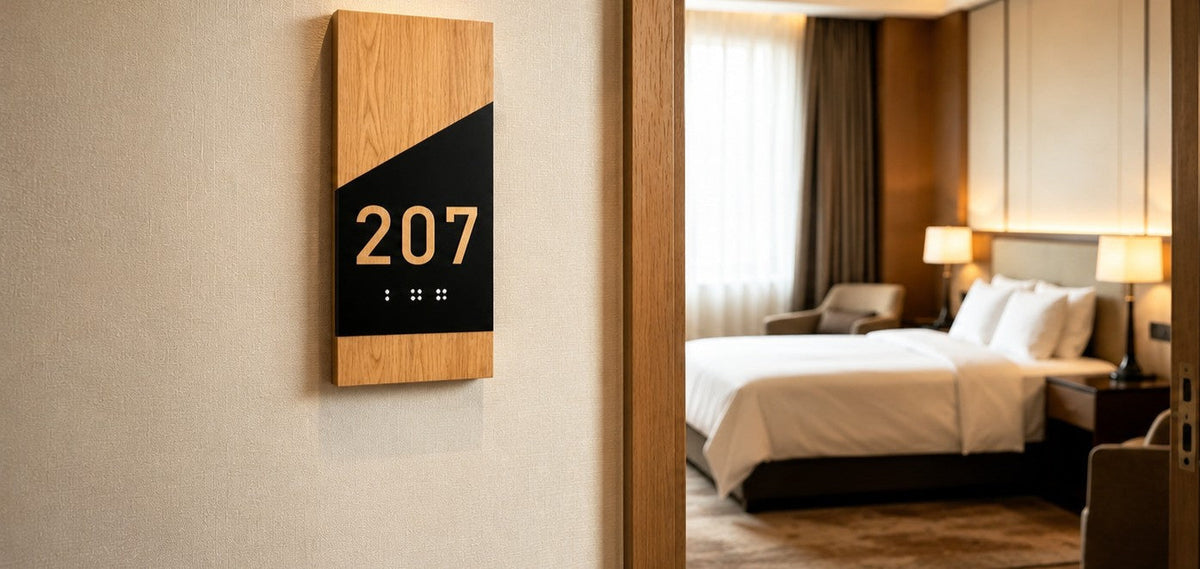
A door sign has a straightforward purpose: identifying a room, area, or destination. Yet in a commercial project, door signs are encountered repeatedly as people move through the space. Their design therefore needs to communicate information clearly while also responding to the architecture, visual identity, and functional requirements of the environment.
This makes door signage more than an isolated informational element. Its role sits between wayfinding, spatial design, branding, and accessibility, with different projects requiring different approaches.
Door Signage Is Part of the Commercial Environment
A door sign is directly connected to the door, wall, or entrance it identifies, so its appearance naturally becomes part of the surrounding environment. Its size, placement, color, and material can either integrate with the existing architecture or provide a deliberate visual accent.
This relationship becomes particularly important when signage is repeated throughout a commercial project. A hotel may have dozens of guest-room and facility signs, while an office, hospital, or school may require hundreds of signs across different areas. Consistency in typography, proportions, finishes, and construction helps individual door signs function as part of a larger signage system.
At the same time, integration does not mean every sign should have the same appearance. The appropriate design depends on the character of the space, the information being communicated, and the users who need to understand it.
The role of door signage is therefore broader than room identification alone: it needs to communicate clearly while belonging naturally to the commercial environment.

Design Language Follows the Environment
Different commercial environments have different functional and visual priorities. These differences influence how door signs are designed.
Hospitality
Hotels, restaurants, and other hospitality environments often place greater emphasis on atmosphere and material coordination. Refined typography, dimensional lettering, wood textures, metal finishes, or subtle illumination can help door signs complement the surrounding architectural and interior design.
Workplace & Corporate
Office environments typically require a clear and repeatable identification system. Consistent typography, room numbering, controlled colors, and standardized dimensions can support navigation while maintaining alignment with corporate identity.
Retail
Retail environments may use door signage more closely in conjunction with branding and customer experience. Brand colors, distinctive typography, dimensional graphics, and contrasting materials can give selected signs stronger visual presence, particularly in customer-facing areas.
Healthcare
Healthcare environments place particular importance on readability, accessibility, and easy identification. High-contrast layouts, clear typography, tactile information, and Braille can help users recognize rooms and services more effectively.
Education
Schools and educational facilities can accommodate a more expressive visual language. Colors, illustrations, dimensional elements, and approachable graphic treatments can make room identification more engaging while maintaining clear communication.
These examples illustrate why there is no single visual style for commercial door signage. The design language should follow the function, architecture, brand, and users of the environment.

Contact us to request a quotation for your signage project.
Material Choices for Commercial Door Signs
Material selection is one of the clearest ways to adapt a door sign to its environment. Acrylic, metal, wood, and mixed-material construction each offer different options for appearance, texture, dimensionality, and finish.
Acrylic Door Signs
Acrylic offers flexibility in color, transparency, layering, and dimensional construction. It can be used for:
- Colored, clear, or translucent surfaces
- Layered and dimensional designs
- Printed graphics
- Face-lit or backlit applications
- Contemporary room identification
This versatility makes acrylic suitable for offices, retail environments, hospitality projects, and other commercial applications.
Metal Door Signs
Metal provides a more architectural and substantial appearance, with the finish having a significant influence on the visual result.
Common options include:
- Brushed finish for a directional surface texture
- Mirror finish for a reflective appearance
- Matte finish for a softer visual effect
- Painted finish for controlled colors and brand matching
- Plated finish for specialized surface treatments
Metal signs can work particularly well where door signage needs to coordinate with architectural metalwork, hardware, or other metal finishes in the space.
Wooden Door Signs
Wood introduces natural texture and visual warmth. It can work especially well when timber is already part of the surrounding material palette or when the project calls for a more welcoming character.
Wooden door signs are particularly suitable for hospitality, restaurants, offices, and other commercial environments where natural materials play a visible role.
Mixed-Material Door Signs
Combining acrylic, metal, wood, or other materials creates additional possibilities for contrast and dimensionality. Different materials can be layered or integrated within a single sign to introduce variations in texture, color, depth, or reflectivity.
This approach is useful when a project needs more distinctive signage while maintaining a consistent design system across multiple locations.

Other Design and Specification Options
Material provides the foundation, but several other specifications can be used to adapt a door sign to a project's functional and visual requirements.
Graphic Treatments
Printed graphics allow flexible use of colors, logos, patterns, and illustrations. Etched graphics can create a more integrated appearance, while raised graphics and Braille provide tactile information for accessibility applications.
Illumination
Non-illuminated signs offer a more understated presence. Face-lit signs make the information more prominent, while backlit signs can create a halo or floating effect. Edge-lit signs emphasize the contours of the sign and can produce a more refined lighting effect.
Mounting Methods
Common mounting options include 3M adhesive backing and standoff screws. These methods create different relationships between the sign and the mounting surface, while suspended mounting can be used selectively for certain retail and commercial applications.
The choice of these specifications should follow the requirements of the project rather than being treated as purely decorative options.
Balancing Function and Design
The most effective commercial door signs balance two fundamental requirements: clear communication and appropriate design integration.
A sign must be easy to identify and understand, but it also needs to work within the architectural and visual context of the space. Material, graphic treatment, illumination, and mounting provide practical ways to achieve this balance.
The result does not have to follow one particular aesthetic. What matters is that the final door sign is appropriate to its environment, consistent with the wider signage system, and suited to the people who rely on it.

LC Sign Door Sign Collection
LC Sign's Door Sign Collection brings together acrylic, metal, wood, and mixed-material door signs for a range of commercial and architectural applications.
The collection covers:
- ADA & Braille Signs
- Luminous Signs
- Acrylic Signs
- Metal Signs
- Wooden Signs
- Office & Workplace Signs
- Hotel & Apartment Signs
- Medical Signs
- Retail Store Signs
- School Signs
We offer full customization across physical dimensions, material layering, surface finishes, LED illumination, and mounting hardware, allowing door signs to be adapted to different project requirements.
Explore the LC Sign Door Sign Collection to see how different materials and specifications can be combined to create door signs suited to the character and requirements of different commercial spaces.
Recommended reading
From Pantone to Production: How Color Consistency Is Achieved in Sign Manufacturing
From Design to Reality: Why Equipment Matters in Modern Sign Production
How Global Logistics Is Being Redesigned for Speed, Cost Efficiency, and Greater Predictability
From Production to Site: How Upstream Optimization Improves Signage Installation Efficiency